Friday, December 7, 2018

Eddie "Rip": Lee Obituary

Eddie " Rip" Lee Nelson was born in Columbus, Mississipi to the late Jim Nelson and the late Cornelia  Brooks on July 24, 1936. In 1951 Cornelia married an awesome man named Tompy Shinn who raised him as his own. He was a graduate of Columbus High School in 1954 and continued his journey into the U.S. Navy and serve 12 years. Later he became an employee of Shell Oil of Amite, LA. He was a very compassionate and loving person to his family and friends. He never minded giving a person a place to reside. "Rip" has a heart of gold and everyone around him knew that of him. May God be with you and rest on.

Eddie " Rip" Lee Nelson will be truly missed but will live on through those that loved him. He leaves behind two beautiful daughters: Lawanda Irving (Hammond, LA) and Ton Irving(Amite, LA). Seven grandchildren that truly loved him and he adored: Treston & Shanna Irving, Madison, and Christian Hill, Jo'elle, Chase & Connor Lacoste. They all truly love their "Paw-Paw." He had one great-grandchild, the precious "Cassius Amir Irving." He had a great caregiver that cared for him 17 years and she was truly a blessing to him; Rosemary Seiber-Watts. There was also Leonard Hickerson as a special friend who was truly a blessing as well. He had many friends that helped him as a well and there is to many to name but they were a blessing to him. 

Eddie Lee Nelson was preceded in death by his parents; Cornelia Shinn & Jim Nelson, Tommy Skinn; one daughter Remina Collins, one brother Paston Johnson, two sisters; Flora Mae Copeland & Mary Warford, one niece Sylvia Renee Warford,  and one nephew Earl Warford.


Source: The Funeral Program of Eddie" Rip" Lee Nelson

Monday, December 3, 2018

Celebration of Life for Mother Willie Mae Dunn Williams

Mother Willie Mae Dunn Williams
Funeral Program
Mother Willie Mae Williams, known affectionately by her family as, "Mae Mae," departed this life on Tuesday, November 27, 2018, in Greenburg, Louisiana. She was born on May 9, 1918, in Centerville, Mississippi to the late Theodore Dunn, Sr. and the late Gladys Chapman Dunn. She was the second child of eight children. In 1949, she married Willie Williams, Sr, and to this union, four children were born. Willie Mae was a devoted and loving mother. Mother Willie Mae was a woman of faith who dedicated her life to Christ at an early age. She began her Christian journey at New Hope Baptist Church in Mississippi. When her family relocated to Louisiana, she joined Brown's  Chapel Baptist Church under the leadership of Rev, Andrews. Later she joined Orange Grove Church of God in Christ under the leadership of the late Sup. Alonzo Richardson and after his demise, she served faithfully under the leadership of Supt. J. A. Richardson until her death.

The church, fashion, elegances, patience, and family, these are all words that describe Mother Willie Mae. During her lifetime, she was a daughter, sister, wife, mother, grandmother, and a friend., but most of all she was a woman of God. She will always be remembered as a loving individual whose greatest passion was serving God and helping others.

Mother Willie Mae Williams leaves to cherish her memories three children: Willie Williams, Jr., (Gwendolyn) of New Orleans, La, Leon Williams (Shelia) of Kentwood, La, and Faye Brumfield (Jeremiah) of Hammond, LA; fifteen grandchildren, forty-five great-grandchildren; three great-great-grandchildren, one brother Leon Dunn (Minnie) and one sister: Ruby Lee Gilmore, both of Kentwood, LA and a host of nieces, nephews, other relatives and friends.

She was preceded in death by her husband: Willie Williams, Sr., her father: Theodore Dunn, Sr., Mother:  Gladys Chapman Dunn; one son: Robert Lee Williams; three brothers, Deacon Theodore Dunn, Jr., Charlie Dunn, Will Henry Dunn, two sisters, Gertrude Perry, and Gena Mae Chapman, one grandson: Robert T. Sibley, and one great-grandson: Willie Williams, IV.


Source: Funeral Program for Mother Wille Mae Williams

Friday, November 30, 2018

Aline Turner Was A Woman of Means

Aline Turner's Bank Book
Photo Courtesy: Lillian Bates

Aline was a woman of some means. She had a bank account with Drexel State Bank of Chicago in 1917.  In 1920, Aline was living in Chicago and she worked as a dishwasher in a restaurant. She was listed as a Mulatto. Aline was born circa 1880. The United States Federal Census in 1920 said that she didn't attend school, but she knew how to read and write. 


When we study our own family history it can tell us so much about our ancestors and ourselves. Certainly, it can tell a lot about the lives our ancestors lived.  Aline also had a bank account at Whitney Bank in 1955 and she managed to save a great percentage of her earnings.  Aline purchased several lots in Ponchatoula, Louisiana. 

Her mother Jane Williams lived in Ponchatoula as well. Jane's mother Mary Miller was born in Virginia and her father was born in South Carolina. Jane was married to Barnard Williams.  According to the 1920  Jane was born abt 1843 in Louisiana. Jane worked as a laundress for a private family in Ponchatoula.  2019 will mark the sesquicentennial of Tangipahoa Parish. Tangipahoa Parish was founded in 1869. For the hundredth anniversary in 1969,  we were in the middle of the Civil Right movement and for the most part, African Americans in Tangipahoa Parish didn't participate in the celebration. For this commemoration, I want to highlight the history of African Americans in this parish. 

Aline William Turner
The history of African Americans has been undocumented and many people including African American people do not know some of the accomplishments and struggles that African Americans faced in this parish. Often times people do not like to talk about things from the past, especially African American people. Some say things were so bad that they just wanted to put  it out of their minds. This is why we have to look inside our own homes for documents, records, photographs, and other information that could be vital to our own family history. 

I want to know more about Aline and how she became a woman of means in a time when women didn't have rights to do many things on their own.  "How did she her mother Mary Miller come to Louisiana? Was she sold down south? Did she come with the slaveholders family? Was she a free woman of color?" There are so many unanswered questions about Aline. The people who could possibly answer these questions are now dead.

At this point, the only thing the family can do is preserve what they have in their processions. And hopefully, genealogy websites like Ancestry and Family Search can provide them with some information.  They may find the names of her children, where they lived, her husband name, occupation, and what year they were born. Sometimes we just have to settle for that information if we can't find anything else. Due to slavery, finding information can be limited in most cases. 

One thing for sure, the women in the family was very industrious. They were women who worked hard to have some financial independence. Aline daughters were just like her, I have come to learn a lot about her daughter Nellie.  Every household sure talk about their family history and share it with others. 

Several weeks ago Aline's great-great-granddaughter Lillian Bates met me in New Orleans to show me her collection. She wanted to leave the collection with me and I couldn't allow her to do that. I didn't want to take responsibility for this priceless collection and for the most part I didn't have the time to scan everything. I knew that it would take me a couple weeks due to my busy schedule. Well, the collection came back to me a second time, this time I didn't say no and I accepted it and made it a priority to scan it and mail it back to Lillian. 

After carefully reading every single documents and piece of paper, I learned so much about the history of Lillian's family and found that her ancestors were trying to tell me something. They wanted me to share their story with everyone, especially their offsprings through my blog. They wanted to tell us that through the most challenging times, they were strong and resilient people. They were determined people, they helped build schools, they stood up doing the Civil Rights Movement and most importantly, they left a blueprint, if only we would follow.

Doretha Baker Jackson of St. Helena Parish, Louisiana

Doretha Baker Jackson
Photo Courtesy: Pat Jackson
Doretha Baker Jackson was married to Sam Jackson. They lived in St. Helena Parish, Louisiana., all their life. Doretha was known for working hard in the field. Her granddaughter Pat Jackson said her grandmother worked in the fields planting vegetables. She died from a heat stroke in the field where she spent most of her time.

Thursday, November 29, 2018

African Methodist Episcopal Churches Made A Donation to CORE

Nellie Turner Berry Collection
This newspaper article was found in the Nellie Berry collection. Nellie was an influential African American woman in Ponchatoula and New Orleans, Louisiana. Nellie was a member of Union Bethel AME Church on Thalia Street in New Orleans, Louisiana after she left Ponchatoula and made New Orleans, La., her home.

According to her granddaughter Lillian Bates, Nellie attended church in Ponchatoula as well. Unfortunately, Lillian can't recall the name of the church in Ponchatoula. All the newspaper clippings and other records in Nellie collection hold the key to some very important church and political history for African American progress during the Civil Rights Movement. 

These influential Religious leaders donated a check in the amount of $635.00 dollars to James McCain, field director for  The Congress of Racial Equality (CORE). The article doesn't give us the date the donation was made.  The article states that's that the check was presented at St. James AME Church.

Nellie Turner Berry
Photo Courtesy: Lillian Bates
Nellie saved another newspaper article about Mahalia Jackson performing at a concert and benefit dinner to raise money for Union Bethel AME Church when fell victim to a fire. Rev. Lutrelle was in high hopes that the concert and benefit dinner would pay off the four thousand dollars mortgage they taken out for renovations after the fire. Mahalia was joined by her longtime friend Elliot Von Joseph Veal an instructor of music at Woodson Junior High School.  He brought with him a chorus of singers from numerous of New Orleans churches.

Reverend Lutrelle Grice Long opened the doors of Union Bethel to Dr. Martin Luther King, Jr., Many  Civil Rights activities too place at Union Bethel under his leadership.  A fire destroyed the building in  1962.  According to Union Bethel A.M.E. Church website, it is said that Dr. King spoke before out to the congregation in 1961 and called for " a new emancipation." He urged the President of the United States to issue an executive order to make segregation unconstitutional by way of the 14th amendment. In 2004 during the 75th birthday commemoration, President George W. Bush spoke before the congregation about Dr. King's legacy.

I'm honored to know that a native of Ponchatoula, Louisiana was a member of a powerful church that played a major role in the Civil Right Movement in the Deep South. I'm anxious to know what else can be found in her collection that can shed some light on her role in the Civil Rights movement.

The 1,500 seating capacity of the Union Bethel auditorium was particularly important during the Civil Rights Movement.  There notable mass meetings were held at Union Bethel. Several Pastors of the Historic St. Peter A.M.E. Church is present in this photograph as well; Rev. T. Gaines, and Reven, F. B. Hitchens. 

After the Civil Rights rally at the Municipal Auditorium was banned by court order, members of the Congress of Racial Equality (CORE) held a prayer meeting in Congo Square outside the auditorium Dec. 15, 1961. They then proceeded to Union Bethel A.M.E. Church, St. Liberty at Thalia. The Rev. Avery Alexander, in in the dark overcoat and gray suit, let the procession. Dr. Martin Luther King, Jr., spoke at the assembly. (Photo by Terry Friedman, The Time-Picayune archives) Terry Friedman.


MAJOR BIBLIOGRAPHICAL REFERENCES

https://npgallery.nps.gov/NRHP/GetAsset/ea7eacec-b1a5-4dca-a5f4-3bfd129d15b4

Lillian Bates and Nellie Berry Collection

New Orleans, Time-Picayune Newspaper, June 11, 1966


Wednesday, November 28, 2018

"Sherman L. Green" Four Freedom Building

Sherman L. Green "Four Freedom Building
This photograph really perked my interest. There are questions that need answers:

Where is the building located?
Who was Sherman L. Green?
Why was it named Four Freedom Building?
Why was this photograph in the Berry collection?

I went to ancestry to see if I could find any records. I found a Sherman L. Green in the 1910 United States Federal Census.  Sherman was married to a woman named Pinky V. Green. Sherman was born in Mississippi abt 1882. In 1910 he was living in Little Rock Ward 1, Pulaski, Arkansas.  He was the President at  Shorter College. Shorter was founded in 1886, a private, faith-based, two-year liberal arts college located in North Little Rock, Arkansas. The college was founded by the African Methodist Episcopal Church. Shorter College is one of the nation's 110 Historically Black Colleges and University and the only private, two-year HBCU in the nation.

In the 1940 United States Census, he was 55 years old and was living in Little Rock, Pulaski, Arkansas. His occupation listed him as a Preacher Bishop and his the highest grade completed was the 3rd year of college. He was a Bishop of the African Methodist Churches. He lived at 900 Ringo Street in Little Rock, Arkansas.

Shorter College graduates, 1912.
Archives State Archives
While researching, I came across a JET magazine "June 11, 1964" Fisk University graduate Sherman L. Green. III, the grandson of AME Bishop Sherman L. Green, was awarded, three major fellowships. With grants for Danforth, Woodrow Wilson, and Fulbright Fellowships. He will use the Fulbright studies, to study comparative literature in France, and then the others.  

Group photograph of graduates of Shorter College posed in front of a brick building on the campus in North Little Rock, Pulaski County, Arkansas in 1912. Graduates include front row (second from left) Carson D. Henry, Rosston, Nevada County, Arkansas; Amoline C. Steward, Malvern, Hot Spring County; Claudius V. Stewart, Malvern, Hot Spring County; Trudie E. Saunders, Argenta (North Little Rock), Pulaski County; Roxie A. Walker, Pine Bluff, Jefferson County; Jessie D. Berry, Clarendon, Monroe County; Sherman L. Green, Pine Bluff, Jefferson County; back row Rev. A.H. Hill (sixth from left) and Rev. J.N. Campbell (eighth from left).


Sources:
Jet Magazine 1964
Building Photograph: Lillian Bates

Uncle Martin Was A Undertaker

Martin Berry
Photo Courtesy of: Lillian Bates
Martin Berry was born in circa 1870. According to the 1930 United States Federal Census. He was born in Mississippi. In 1930 he was living in Ponchatoula, Louisiana. He owned his own home and the home valued at three thousand and five hundred dollars. He was married to Almeda Berry. Martin and his wife had a grandson by the name of Willie living in the household with them. Martin and his brothers were carpenters.

In the 1910 United States Census, he and wife were the parents of Thomas, Clarence, Alfred Berry.  A little girl named Bertha Brown was living in the house. Martin was able to read and write.

On the back of the photograph, it is written that he was a professional undertaker. (Uncle Martin, a mortician), Edward John Berry's brother.


Tuesday, November 27, 2018

Aline Turner Was A Pioneering Woman of Ponchatoula, Louisiana

Aline Turner Johnson
Photo Credit: Lillian Bates
Several weeks back, I met a woman named Lillian Bates through one of my social media sites who told me that her family roots are tied to Ponchatoula, Louisiana. Ponchatoula is presently known for the annual strawberry festival. But there isn't much documentation on African American people who lived in Ponchatoula. Some migrated there and became strawberry pickers and others work at one of the timber companies. 

Through the many conversations Lillian told me about her rich family collection of photographs and other documents. I was intrigued to hear about the collection and couldn't wait to see it. When we made plans for me to see the collections, I was truly amazed at the land records, photographs, and other vital information that can help us take a look at the Turners, Bates, Buchanan, and Berry family. 

Learning about life during for African Americans in the Louisiana Florida Parishes during and after Reconstruction can help us to write or re-write the history books. Reconstruction was implemented by Congress and lasted form 1866 to 1877. 

Aline was one of the children of Barnard and Jane Williams. She was born abt 1879 She owned several lots in Ponchatoula and Aline kept very good records. Aline was married twice, first to Alex Johnson and second to Isaiah Turner.  According to the 1910 U.S. Federal Census, Aline and Alex  had three children.  She passed away in 1949.

In the collection was original copies of tax records, letters, receipts, and photographs. A copy of her funeral expenses from Campbell's Funeral Services, Inc.  Her funeral services cost $290.00 dollars. Her daughter Nellie Berry made sure that the services was paid for in full.

Aline appeared to be a woman of some means. She purchased land and a home for her family. The census  said that she knew how to read and write.

Thursday, November 22, 2018

Tulsa Race Riot Survivor Dr. Oliva Hooker Died at 103

Living Legacy Award Recipients
Photo Credit: Walter C. Black, Sr.
Dr. Olivia J. Hooker, a survivor of the 1921 Tulsa Race Riot and first African-American woman to enlist in the U.S. Coast Guard, had died at age 103. She was born on February 12, 1915, in Muskogee, Oklahoma. Dr. Hooker was only six years old when she and her three siblings hid under the table while the Ku Klux Klan ransacked their home. 

She applied to the Women Accepted for Volunteer Emergency Service for the U.S. Navy but was rejected due to her ethnicity.  She fought the rejection due to a technicality and she was accepted. She received her Masters in Psychology. Dr. Hooker was one of the founders of the American Psychological Association. I had the pleasure of being one of the women along with Dr. Olivia Hooker in 2013 to be a recipient of the Living Legacy Award presented by Association for the Study of American American Life and History (ASALH). 

I was seated at the same table with a living legend and I wish I had the time just to sit and talk with her about her experience. With over 180 nominations, nineteen women were chosen to receive the Living Legacy Award at the 87th Annual Black History Month Luncheon, February 23, 2013, at the Marriott Wardman Park Hotel in Washington D.C. 

Sunday, November 18, 2018

Josephine Woolridge Edward of Montpelier, Louisiana

Josephine Woolridge Edward
1896-1974
On October 29, 1974, Sister Josephine Woolridge Edward departed his life at 9:35 p.m., at the home of her sister, Mrs. Easter Woolridge Vining in Montpelier, LA.  

Mrs. Josephine Woolridge was born June 10, 1896, to the wedlock of Mr. Harris Woolridge and Mrs. Irene Smith Woolridge and later she met and married Rev. Arthur Edward, who preceded her in death. One son was born to this union, he also preceded her in death. 

Sister Josephine was converted at an early age at Old Tinners A.M.E. Church under the leadership of Rev. Tom Richardson which later became Morgan Chapter A.M.E. Church of Montpelier, LA. 

She was a faithful member and served on the Stuardress C Board and was a member of the Missionary. She was always willing to lend a helping hand to everyone in the community even though sometimes sick. 

She leaves to mourn, one sister, Mrs. Easter Woolridge Vining of Montpelier, LA., four brothers, Rev. Lee Woolridge of Montpelier, LA, Ferdann Woolridge, and Mr. Jerdan (Teran) Woolridge both of Amite, La., and Mr. Charlie Woolridge of Hammond, LA and a host of relatives and friends.

Tuesday, November 6, 2018

Barnard and Jane Family Williams History of Ponchatoula, Louisiana

Barnard and Jane Williams Family History
Ponchatoula, La: Courtesy Photo Courtesy: Lillian Bates
Jane Williams was born in Ponchatoula in 1855. She was married to Barnard Williams also known as Ben R. Williams. In 1920 Jane lived on Ferch Road in Ponchatoula. She and Barnard gave birth to 12 children: Aline, Wisteria, Ella, Ellana, Alfonse,  Clinton, Sillsteen Mclure, Minard, Cora Daniels, Eunice, and George.

I posted a picture of an old house I took at Brittany Austin home in Ponchatoula recently and the response to that photograph opened up other communications about African American families who lived in Ponchatoula. A woman named Lillian Bates contacted me through facebook and shared some beautiful photographs of her family who lived Ponchatoula, Louisiana.  Jane was the daughter of Mary Miller.   Mary was born circa 1815 in Virginia. According to the 1880 U.S. Census, she was living with her daughter Jane and her son-in-law Barnard Williams.

George Williams
Courtesy of Lillian Bates
Lillian's ancestors were landowners and most of them were Laundress. Jane didn't know how to read and write according to the 1930 U.S. Census. One of the most notable history makers were Rev. Arthur Tasker, who became the first African American mayor to be elected to Ponchatoula in 1870. Jane was neighbors to Rev. Arthur Tasker and her son Clinton Willimas was on the board of Trustees. 

Their son George lived at 255 E. McClellon Street in Ponchatoula. George photograph is just one of the photographs in the Williams family photograph collection.  Lillian Bates is a direct descendant of Althea Bates and Milton Andrew Foret. She is the granddaughter of Lousie Berry. She left two children behind: Althea and Lionel Bates. Her sister Nellie raised her two children.

Jane's daughter Aline owned an eight lots in the City limits of Ponchatoula.  Lots 1, 2, 3, 4, 5,  6, 7, and 8 in Ward 7. Aline purchased the lots from Jacob R. Ables in 1947 for a sum of two hundred and fifty dollars.

When Aline died, her remains were trusted to Campbell Funeral Home in Hammond, LA, in 1949.  Aline was married twice, first to Alex Johnson and second to Isaiah Turner. Barnard and Jane's children married into the Turner, Johnson, Buchanan, Owens, Nelson, Corley,  families Daniels that is noted.

I asked Lillian how did she get the rich collection.  "My grandmother kept everything!" said Lillian. I have bags of other photographs and documents Lillian said. Lillian is one of the people who inherited a rich collection and want to preserve it.  After my workshop, I had a small window of time to look at her collection,  and I can assure you I have to make some more time to spend with her.
Louise Bates
When others share their family history we can learn more about the areas we are researching. It's people like Lillian who holds the missing pieces to the puzzle that can help paint the picture and tell the story. Not only does that pictures tell a story, but the documents that she had.  One document she had was the funeral record dated back the 1940s of her Aunt Aline's funeral.  In the collection, you will find High School Diplomas, land records, handwritten letters, and other documents that tell the story of land ownership for the Williams Family.

As a genealogist and family historian, we are always delighted to hear that someone like Lillian inherited her family collection. Because often times, the collection can end up in the hands of someone who may not place any historic value on the collection and they will throw it away. 

Saturday, October 20, 2018

Images of America " African Americans in Tangipahoa and St. Helena Parishes

Please mark your calendar to join Dr. Antoinette Harrell the author of Images of America "African Americans in Tangipahoa and St. Helena Parishes on November 5, at 6:30 at the Amite Library.

She will be joined by Monteral Harrell Climmons, Annie Lee Hurst, Glyniss Vernon Gordon, Dr. Kingsley B. Garrison, Mrs. Grace Walker Perry, and Earl Wheeler. They are the owners of a rich family photograph collection and they hold precious memories in their photograph collection. They decided to share it with others through this book.

Dr. Harrell will talk about the development of the book and the importance of preserving family images.  Each contributor will briefly talk about their rich collection and why they felt compelled to contribute to the book. 

The Louisiana Journeys: A Local History Series. Louisiana's history is a long and winding road. Take a trip as we reveal forgotten stories, influential people, and historic documents and photographs during this three-part presentation. For more information please visit the www.tangilibrary.com

The contributors will have on display some of their photographs from their collection. Several of the contributors inherited the images from a loved one who passed away and others are the original owners of the collection. We hope to see you there and please bring a friend.


Saturday, July 28, 2018

Name Clarification for Temple Cemetery in Amite, Louisiana

Temple Cemetery
Photo Credit: Antoinette Harrell
A couple of years ago, Edwin Temple and I discussed the name of a cemetery in Amite, Louisiana, after he read some of my historical publications about the cemetery. Edwin informed me that the name needed to be corrected. He said that name of the cemetery is Temple Cemetery and not Temple-Bush Cemetery or Bush-Temple Cemetery.

I recorded nine African-American cemeteries in St. Helena and Tangipahoa Parish, Louisiana.  Temple Cemetery was of the nine cemeteries recorded.

According to some of the funeral programs, the cemetery is called three different names; Temple Cemetery, Temple-Bush Cemetery, and Bush Temple Cemetery.  According to Edwin's family history, his great-grandfather Jim Temple was married twice. First to Margaret Amacker, and secondly to Orthell Butler.  Jim's second wife Orthell Butler Temple donated two acres for a cemetery for all their descendants from both marriages. The family wants to correct the inaccuracies and make sure that everyone note that the name of the cemetery is "Temple Cemetery" some of Jim and Orthell descendants are discussing placing the Temple name as the official name for the cemetery with the State of Louisiana and Louisiana Florida Parishes. Because the cemetery is known by three different names, it is confusing some of the heirs and people in the community.

According to several newspaper obituaries and funeral programs for the deceased quoted the interment for the deceases all three names were used. The Temple family want the cemetery to carry the only name of Temple. The family plan to notify all funeral homes in written letters concerning the official name once it recorded the Tangipahoa Parish Clerk. 

The Temple cemetery is a private cemetery, and there aren't any officials in the parish clerks office. For clarification Mary Temple was married to Tony Bush, Sr., After Mary passed away she Tony Bush, Sr. married Pearl Mae Clark. Any descendants from Tony Bush, Sr. and Pearly Mae Clark Bush  shouldn't be buried in the Temple accord all descendant of Jim Temple.

Sunday, July 1, 2018

O.W. Dillon School to Be Placed on the the National Register of Historic Places


 Delegation Visited  O.W. Dillon School
Photo Credit: Antoinette Harrell
This past week a delegation organized by Dieone Johnson, Executive Director for O.W. Dillon Preservation Organization met with Jessica G. Richardson, National Register Coordinator, Division of the Historic Preservation, Office of Cultural Development. The delegation and Executive Director toured the school with Jessica, educating her about the history of the school.  

The National Register of Historic Places is the official list of the Nation's historic place worthy of preservation. Authorized by the National by the National Historic Preservation Act of 1966, the National Park Service's National Register of Historic Places is part of a national program to coordinate and support public and private efforts to identify, evaluate and protect America's historic and archeological resources. 

Tangipahoa Parish Training School is the oldest in the Nation. ]The school is gaining national attention for its historical Heritage in the African American community.  The doors opened in 191l and closed several years back. The school fostered the idea of having boys learned scientific agriculture, dairying, and horticulture for girls; sewing, domestic economy, cooking, and other life skills training.  The Tangipahoa Parish Training School drew many students from surrounding parishes, including Washington,  St. Tammany, St. Helena, East and West Feliciana. Some students came from Mississippi to get an education. 

The delegation toured the school that could be used as Community Enrichment Center,  Museum & Cultural Center, and a vocational training school. They visited the classrooms, gymnasium, the cafeteria, and the school grounds.

During the visit, Susie Bates and Valeria Temple Thompson alumni's of the school reminisce about their school days and the staff of the school. Also attending were local historian and television talk show host Antoinette Harrell joined the delegation to help them document the rich history of the school. Youth photographers; Connor, Chase and Jo'elle Lacoste took pictures for photo documentation. 


O.W. Dillon School
Kentwood, Louisiana
Photo Credit: Antoinette Harrell

O.W. Dillon School
Kentwood, Louisiana
Photo Credit: Connor LaCoste


O.W. Dillon School
Kentwood, Louisiana
Photo Credit: Connor LaCoste


Saturday, June 23, 2018

Images of Tangipahoa and St. Helena Parishes, Louisiana: Part of the Images of America Series

For the past seven months, I have been traveling throughout Tangipahoa and St. Helena Parishes, Louisiana collecting photographs of African American people to be a part of the Images of America Series. I collected military, school, church, civic and social organizations, educators, farmers, elected officials and other pictures for the upcoming book. I couldn't have done it without the help of Glyniss Vernon Gordon, Dr. Kingsley Blaine Garrison, Mr. Lawerence Spears and his wife Arizona "Tat" Earnest Spears, Shan Gordon, Mrs. Ella Mae Badon, Earl and Vera Wheeler, Edwin Temple, Mrs. Grace Belvins Walker Perry, Annie Lee Hurst, Leonard Smith, and Montreal Harrell constant support. Certainly I want to thank my grandchildren for assisting me. There were days when everything seem so overwhelming and difficult, but I had to move forward to finish the book. I want to thank Melody Ricketts for offering her help and encouraging me. 
The Johnson Family
Courtesy of Myrtis Cook

The publishing company emailed me last week to inform me that the book will be available this coming December. The book is rich with 214 images and text. I learned so much about the people of this parish and their compelling stories and I'm excited to share these stories with the world.  Many of their stories are undocumented and not written in the history books. The community narratives and images  will help give scholars, researchers, and writers a broader perspective about African Americans people of the two Louisiana Florida Parishes. Each photograph in the nine chapters represents the communities the unsung trailblazers call home. I looked at so many amazing photographs inside of shoe boxes, albums, and dresser drawers. Some images that were taken around the late 1800s to early 1900s should be displayed in museums and preserved in archival repositories. 

These photographs can change how we see ourselves. The images frozen moments in time so that we can reflect upon today. We can learn a great deal about the past from the pictures. After Arcadia Publishing Company approved the images and quality, there are many images that wasn't selected and  I'm thinking about what I'm going to do with the others. The promotional team is working on the promotional release for the upcoming book and I will post it on all my social media sites. 

There is a sense of pride I have just knowing that the people and trailblazers have been written in the Arcadia Publishing and History Press Collection. Last but certainly not least, I want to acknowledge Dr. Howard Nicholls for inspiring and suggesting that I publish this book. 


Wednesday, May 9, 2018

Who Remember Perry's Drive Inn in Butler Town in Amite, LA?

Perry Drive Inn
Photo Courtesy: Antoinette Harrell
Back in the late 60s my mother would stop at Perry's Drive-in and bring home some of the best tasting mouth-watering grilled hamburgers from Perry's. Perry's was owned by Lois and Esther Irving Perry, they were an icon in the community.  Glyniss Vernon Gordon, my grandson Connor,  and I stopped to take few pictures and I decided to ring the doorbell to find someone to talk with. A young man I met last year came out and, I was happy to see him. He told me that he was the great nephew of Floyd and Lois. Blair Williams is name and Blair has a great interest in his family history. He told me that I needed to talk with his father, Donald Williams. We sat under the carport the catching some of the cool breezes and talking about a little history and the importance of passing it on.

"My father is the one you should be talking with," said Blair. He and my uncle can tell you more then I can.  Blair called his father on the phone, and his father said that he would be right over. While waiting for his father to come, Blair told me about some pictures on the wall and I wanted to see the images. 
Donald Williams and his son Blair Williams
Photo Courtesy: Antoinette Harrell

As soon as Donald arrived and greeted us, he offered us something to cool to drink as most people in the Deep South would do. He sat down and started talking a little about the Lemuel Irving history and how Lem remained in the Town of Roseland. Donald lit a cigarette and start going back down memory lane. I started traveling down memory lane with him. I wanted to know more about Perry's Drive Inn. 

Everybody came to Perry's Drive Inn. It was the place to be. My Aunt Lois was a good cook, she enjoyed cooking and did it well he said. She would get up early in the morning and cook breakfast, dinner, and supper. "You see, back in those days lunch was called dinner and dinner was called supper," said Donald. Aunt Lois cooked every day three times a day and,  that was just the way it was. Donald said that the cost of lunch was fifteen cents back in his day. One day he went to school and gave a boy his fifteen cents for a sandwich. I wanted a sandwich because Aunt Lois never gave us sandwiches to eat not even on the weekend.

Glyniss recalled the many communities and political meetings that were held at Perry's. There were other African-American owned businesses in the communities. Donald mentioned Steptoes Lounge and some of the musicians that played there. I heard Blair say that Al Green played there and I was once told by someone that James Brown played there. 

I post a picture of Perry Drive Inn on my social media site to generate conversations around the images. I read the comments that were posted and want to share a few of them. 

Robert Daniels Best ' Fish' boxes. Delicious! A very Clean and comfortable place. Maybe someone will decide to reopen it. May need a little remodeling on the inside.

Priscilla Jackson Yes I remember going to Perry's Drive Inn the best burgers, fish plates, fries, and malt shakes you ever tasted. The atmosphere was like everyone was family. Boy, I missed them days.


Atlanta Marie Daniels Woods I remember going there with my mama and brother and sisters on Friday night's and we would eat and play music on the jukebox. A great childhood memory!!!! I miss those days.


Sharon Boykins Brown Teenagers could hang out and get some really good food!

Michael Woods Boy! how do I remember those days best burgers milkshakes in town?

Sharetta Richardson Best cheeseburger and fries ever $3.26.


Early Photograph of Amite No 1 Church of God in Christ


Amite No. I Church of God in Christ
Photo Courtesy:  Rev. Raymond Foster, Sr. 
Over the past couple of months, I've set in the homes of many people whose family ties are deeply connected in St. Helena and Tangipahoa Parishes, Louisiana.  Years ago Delores Zanders Levy passed away and her mother archival collection was passed down to Rev. Raymond Foster, Sr., and when I say that he was the right person to inherit the rich collection, I mean it with everything inside of me. Too often we hear that someone threw away all the pictures, documents, and other records that can help tell the story and history of African-American people of the two Louisiana Florida Parishes.

About two years before Delores passed away I visited her home to talk with her about the family history and photographs. My maternal great-grandmother Emma Mead Harrell was the aunt of her mother Colitidle Zanders." Mrs. Clotilde kept everything," said Rev. Foster. She did throw away anything.  In her own right, she was an archivist.

There are other women in the community that kept the history of churches, schools, civic and social organizations and well as their own family history and photographs. Rev. Foster is quite an oral history keeper himself. I learned more about the Foster Family history from him on this visit. Women such as; Grace Belvin Walker Perry,  Alma Harrison Vernon, Gertrude Love, Zemora "Hilda" Vining and I know there are others.

There was this one statement he made about the history of a small community in Tangipahoa Parish called Shiloh. He told Glyniss Vernon and me if we look at one of the old Plat Maps, we'll find that Shiloh was called "Congo Square" I can't wait to do more research on this subject.  It will be posted it right here on Nurturing Our Roots Blog Site.

This photo is the Amite NO.1 Church of God in Christ. From left to right; James Sheridan, Irma Della ?., Celestine Foster, Annie Edwards, Edna Buckley, Christine Alle, Algia Mae Spears, Irene Benton, Leola Buckhalter, Lolly Edwards, Mrs. Freddie Cage and husband Eld. Freddie Cage, Second Row: Left to Right; Celie Love, Mildred Warner, Tina Jackson. 

Tuesday, April 24, 2018

Documenting the History of a Civil Rights Icon Mrs. Vernia McCoy

Antoinette Harrell interviewing Mrs. Vernia McCoy
I spent an hour sitting and talking with Mrs. Vernia, a citizen of Tangipahoa Parish, Louisiana. We sat her dining room table looking at documents and photographs. Several years ago I interviewed her, and when I tell to you, it will take me a year to document her oral history and her rich photograph collection that tell the story and event of many African-American people in the Louisiana Florida Parishes.

Each time I learn so much about her life and the life of her deceased husband Mr. Fred McCoy and the many challenges they faced during integration in Tangipahoa Parish. She was born and reared in Franklinton, Louisiana with her parents and eleven brothers and sisters.  Mrs. McCoy is a retired A.M.E. Pastor of  St. James A.M. E. Church in Hammond,  Louisiana., and educator.

I feel honored to talk with people such as Mrs. McCoy, Dr. Kingley B. Garrison, Mrs. Ella Mae Badon, and Mrs. Grace Walker. They are the living history books that we must treasure and most importantly document according to their experiences as pioneers in the Louisiana Florida Parishes.  As of today,  Mrs. McCoy is involved in many community outreaches.

This is just the beginning of the many hours I will be sitting with her to assist her with organizing her collection for the repository at Southeastern Center for Louisiana Studies. She has accomplished and achieved so in her life and her career. She has so many awards for her accomplishments and achievements over her lifetime. 


Thursday, April 19, 2018

A History Road Trip with Family

Bernard mailing his African Ancestry DNA in
Virginia
When my youngest son Bernard was a child, we visited many, archives, libraries, and museums.  By the time he turned twelve years old, he had traveled to twenty-two states. Tasting different food and meeting new people along the way. Sometimes we flew, and for the most part we would drive so that we could stop and visit some of the major attractions. 

With a big smile and his luggage packed he was all ready to travel on our summer adventure.  We made plans to take a road trip for two weeks driving up the East Coast and ending up in Washington, D.C, at the National Archives.  He was too young to go into the National Archives, so my ex-husband took him around College Park while I did some genealogy research.  I don't know how much of the history lessons he was retained at that time. I know I had to teach and expose him.

It was one of the best summer vacations we can remember. We purchased a map for him to follow along. We packed books and some of his favorite things he enjoyed playing with and hit the road headed  east.  During that time they didn't have a GPS to guide us on our trip. We made sure to purcahse postcards in each state to send back to the family at home. 

Reading records 
Years later we took another road trip with Moussa Albaka, a well known Tuareg silversmith to meet other Tuareg people from Niger, Africa who moved to Greensboro, North Carolina.  We're welcome with big smiles and hugs by the Tuareg people. We had dinner and wonderful conversation before head to the Atlantic ocean so that Bernard could take his African Ancestry DNA test.

He faced the ocean and imagined the ships coming to the Americas with his ancestors on it. We held each other in hopes that he will find out where in Africa his paternal ancestors come from. Six weeks later he finds out that his paternal lineage connected him to Nigeria, West Africa. 

Learning about our family history had taken us many beautiful places to meet some wonderful people and new family members along the way. As I write this blogpost, I can't help but think about the time Bernard and I drove to Chicago to visit our Harrell family member with my Uncle Raymond.  Bernard has just met his 3rd maternal cousins. He met cousins that his maternal grandmother hasn't met. I was happy that we took this trip that summer.

Uncle Raymond played one of his old-time gospel songs again and again. It seems like he played that song from the time we left Louisiana to we arrived in Chicago. Bernard asked him why did he keep playing the same song over and over again?  During our stay in Chicago, Uncle Raymond wanted us to meet the descendants of my great-uncle Warner Harrell.  So the three of us drove up to Wisconsin and met new family, and we really enjoyed our visit with cousin Dan Harrell and his family.

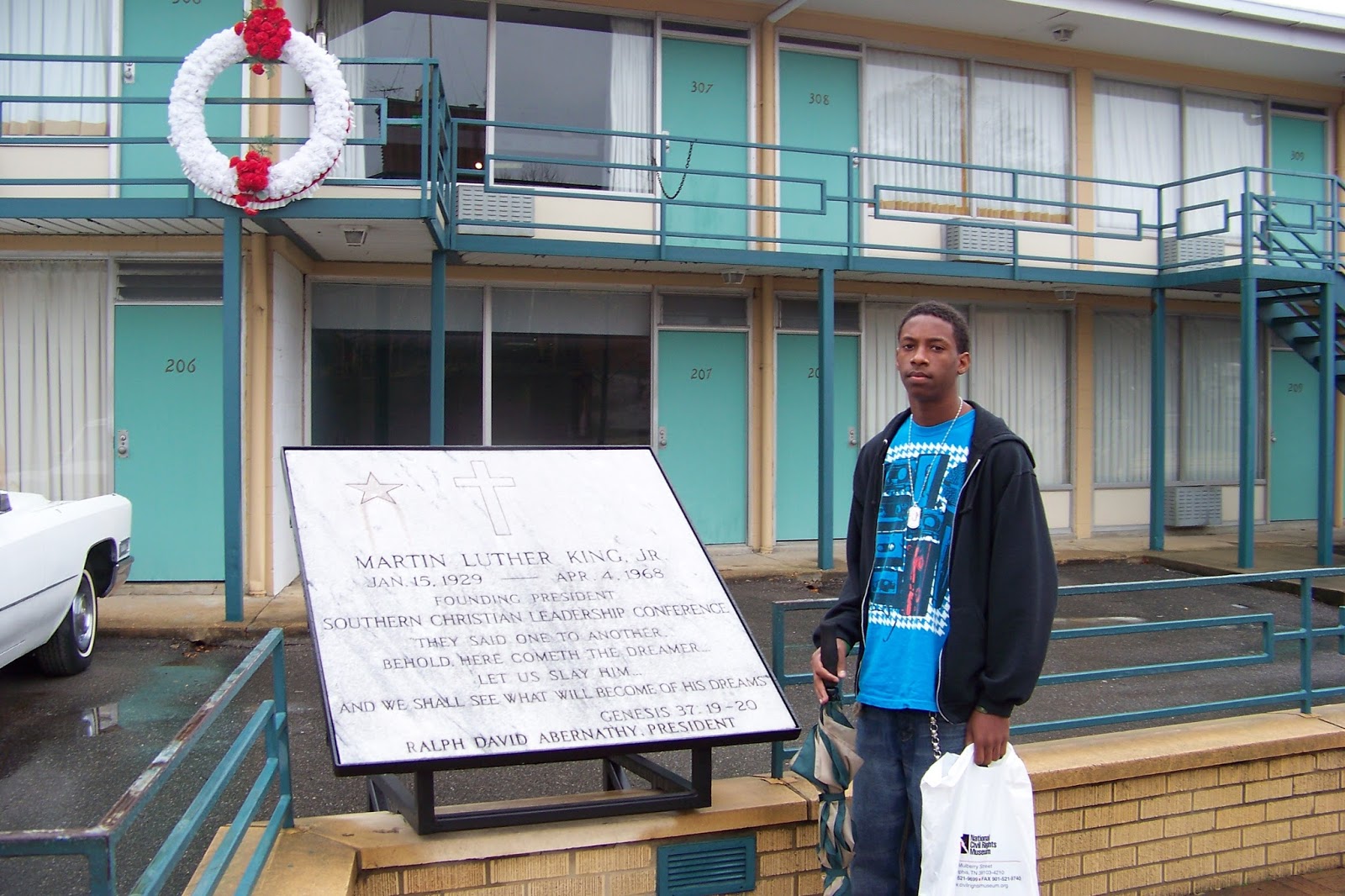
One week the white lines on the highway were calling me again. I asked Bernard if he wanted to go and visit the Civil Rights Museum in Memphis, Tennessee? He said yes and was eager to go. We packed our luggage on a sunny Friday afternoon and drove the five-hour trip. We went west to visit Alex Haley House Museum in Henning, Tennessee first.  We took the guided tour and took pictures before traveling back to Memphis to get dinner and checking in the hotel. 

The next morning after breakfast we headed to the National Civil Rights Museum and spent the day touring the Museum. What better way to teach a child about the history? He had a lot of questions to ask about the Civil Rights Movement.  I hope when he becomes a father, he'll take road trips with his children and teach them their history. One thing for sure the road trip we took by driving meant that we could stop all along the highway and get some good tasting food and site see. 

I hope he holds these memories dear to his heart like I hold them in my heart. This was our time spent together. Now that he is an adult we haven't taken a road trip and just because he is all grown-up, doesn't mean we shouldn't.  My grandchildren are taking road trips with me now.   They'll soon  become teenagers and they will have other plans. But the beautiful and sweet memories I hope will never be forgotten. 
I enjoyed taking him places with me and having him to be a part of the many events we went to. The only thing I regret is I wish that we could have had more time in his formative years. The time went by quickly that once little boy is now twenty-five years old. 

I want to make it a family tradition that we all take a road trip to visit museums, antique shops, fun attractions, and enjoy family time spent together.