Tuesday, February 14, 2023

Hurricane Ida damage headstones and vaults at Rocky Hill Cemetery

Damaged Vault
Rocky Hill Cemetery
Photo Credit:  Dr. Antoinette Harrell
In the aftermath of Hurricane Ida, I visited Rocky Hill Cemetery. There is a cemetery there where my maternal 3rd great-grandparents Thomas and Amanda Breland Richardson are buried. Both lived their entire lives in St. Helena Parish. I have visited the cemetery for decades to record the inscriptions on the headstones. It is  easy for me to recall driving down the gravel road to the church where they both worshipped. Many of the surnames in the cemetery are familiar to me. Tanner, Vining, Richardson, Chaney, Jackson, Glaspy, Self, Bush, Porters, Johnsons, Hurst, just to name a few. 

The cemetery was damaged by several trees that fell on graves. There were some graves that were seriously damaged. Several headstones lie broken on the ground with large holes. Hopefully, the headstones and vault can be repaired. Otherwise, these monuments will disappear forever. If you have family buried in Rocky Hill Cemetery, you may want to visit the cemetery to check on their graves.

We should rethink planting trees in cemeteries and cutting them down before they become unmanageable. It is also imperative to consider the roots and the damage they can cause. There is no doubt that such repairs can be costly. Since COVID-19, headstone prices have increased significantly.   The deceased loved ones may not live in close proximity to the cemetery and can be unaware of the damages. It would be great if you could visit the cemetery.  The deceased loved ones may not live in close proximity to the cemetery and can be unaware of the damages.

The grave of Willie Richardson
Rocky Hill Cemetery, St. Helena Parish
Photo Credit: Dr. Antoinette Harrell


Hammond Magnet School focus on local history for Black History Month

Hammond Magnet School
Photo Credit: Mr. Kip Andrews

Dr. Antoinette Harrell was invited to speak at Hammond Magnet High School in Hammond, Louisiana to celebrate Black History Month. At the beginning of the week Mr. Kip Andrew had the students research and learn about the history of two African American churches in Hammond, LA.,  St. James A.M.E. Church was founded in 1867. The church is still standing and active to this day. The second oldest church Greenfield Missionary Baptist Church was founded in 1870. Mr. Andrews pointed out that both churches are huge milestones within the African American history in Hammond, Louisiana.  

"Having the students to explore and study local history is important. Oftentimes, we look at history on a national level. Sometimes people over look local history makers, icons, and pioneers, "said Harrell. Harrell stress the importance of exploring local history. Matter of fact, many of the students can be related to the local history makers she said.  Mr. Andrew said that the students are working on a hard back book of the local history. Harrell volunteer to assist in anyway that she can. 

Harrell was impressed with the interaction from the students. Some of the students had several questions for Dr. Harrell. They had good questions and comments concerning the information that Harrell shared. 


St. Helena Parish Clerk on a mission to preserve local records and creating online access

Mildred Cyprian
St. Helena Parish Clerk
Photo Credit: Dr. Antoinette Harrell
 
I have conducted genealogy research for the past 30+ years at the St. Helena Parish Clerk's Office in Greensburg, LA. My family history traces back to St. Helena. It has always been an enjoyable experience for me to conduct research at the Clerk's office. In terms of preserving the records, I have seen tremendous changes in the last eight years.  I'm  impressed with the hard work Mildred Cyprian and her staff put into preserving records at the Clerk's Office. 

Just recently I learned that mortgage and conveyance records from 1983 to present is available online. This is a major step for Clerk's Offices located in rural communities to take. St. Helena has never had a fire to take place like many courthouse across the country. Some of the records dates back to the early 1800s and need to be protect and preserved. Many are crumbling up at a touch.  It's like watching a little piece of history be destroyed forever through each crumbling piece of the paper. "What can we do about it?" Collaborating with experts in this area would be the first step to take. These records certainly should be scanned in order to continue preserving them. I would like to set up a meeting with the Clerk to discuss possibilities.  

Previously, a briefcases and folders could be brought into the vault. Although we can no longer enter into the vault. You still have access to the records.  Whatever you need from the vault,  Denise Godfrey, the Key Deputy Clerk, will be glad to assist you. I'm in agreement as a genealogist and local historian.  It is not uncommon for  records be stolen and lost. It may be difficult for some people to understand this change. It is necessary to make this change in order to protect and preserve the records. The records in St. Helena Parish hold the key to understanding our parish's history. I'm very pleased with the new changes that I see each time I visit the clerk's office to conduct genealogy research. In recent years, the clerk's office has become more popular with genealogists and local historians. St. Helena Clerk's Office has been visited by groups from all over the country for research. 

Please visit:

https:eclerksla.com/Home


Monday, February 13, 2023

Ephraim Bates Succession and Probates 1829, St. Helena Parish Files B-1

Dr. Antoinette Harrell
Conducting Genealogy Research 
St. Helen Parish Clerk's Office


March. 23, 1829- Inventory: a tract of which decd lived 640 a traced called he William tract 640 acres; 13 slaves, etc. Total inventory $14, 569. 


One negro woman named Eda, one hundred dollars.

One negro woman named Hilda, four hundred dollars.

One negro man named Simon, six hundred dollars.

One negro man named Moses, four hundred dollars.

One negro woman named Charlotte, two hundred dollars.

One negro woman  named Rhoda,  four hundred dollars.

One negro woman  named Lydia and her two children, seven hundred and sixty dollars.

One negro woman  named Pleasant, two hundred and eighteen dollars. 

One negro man named Mark, seven hundred and sixty dollars.

Sunday, January 29, 2023

Civil Rights Leaders Climon Ricard Sr, of St. Helena, Louisiana

Climon Ricard
Military Draft Cart
Ancestry
Climon Ricard, Sr.  was born on July 30, 1915 to George Samuel Ricard and Susan Ricard. He died on November 15, 1992. Climon is buried at Mount Zion Cemetery in St. Helena Parish.  Climon was married to Helen Simlin. Cited in the 1940 United States Census, Climon was living in St. Helena Parish on Road No. 333. He was a farmer by occupation. He was working on his own account.  Researching the 1920 United States Census, he was living in New Roads,  Louisiana and was listed as a mulatto. Ten years later Clemon Ricard and his family was living in Police Jury Ward 4, St. Helena, Louisiana. 

As a member of the Citizens Voter League Board of Directors, Climon Ricard represented St. Helena Parish. Ten directors from St. Helena Parish served on the Board of Directors in 1950. As a result of the right to vote in 1950, Climon put his life on the line. The vote was a powerful tool for his life as well as that of African American people in St. Helena Parish. 

Livingston Parish Civil Rights Leader Lester Youngblood

Lester Youngblood
Courtesy of
 Bernice Alexander Bennett
Funeral Program Photo
I'm familiar with the name Youngblood since author and genealogist Bernice Alexander Bennett comes from the Youngblood family. Often she talked about her Youngblood ancestry from Livingston Parish. Recently I was at the Tangipahoa Parish Clerk's Office researching charter documents and found a the charter for the Citizen Voters League. 

Among the 36 names mentioned in the charter was Lester Youngblood. Her confirmation was that there are two Lester Youngbloods: Jr. and Sr. Bernice forwarded me a copy of Lester Youngblood's funeral program. Among the civil rights icons in Head Island, a parish in Livingston, was Lester Youngblood, Sr. 

Lester was born on August, 7, 1914  to Wesley Youngblood and Fannie Walker in Head Island, Louisiana  He passed away on May 32, 1997 at his home. He was married to Dorothy Martin Youngblood. They were the parents of 16 children.  10 daughters and 5 sons: Dora Youngblood  Harris, Elnora Youngblood Quiet, Margie Youngblood Hawkins,  Helen Youngblood Raven, Georgiana Youngblood Jackson, Lillie Youngblood Davis, Jessie Youngblood Hart, Daisy Youngblood Norman, Barbara Youngblood Thomas, Toni Youngblood Jackson. James Youngblood, Elgene Youngblood,  John C. Youngblood and Henry Youngblood.  When he passed away he had 55 grandchildren, 74 great-grandchildren, and 8 great-great grandchildren. He and his wife had a very large family 

I used Ancestry to learn more about the man who put his life on the line for the right to vote. Lester realized that during that time in the Deep South. I found information on the U.S. World War II Draft Card. His bright day was listed as 1914, he was born in Head of Island, Louisiana and was employed at McCarrol Lumber Co.  In the United States 1940 Census he was working for as a logger for a Sawmill Company. Lester owned his home in 1940. 

Standing up for that right to vote, Youngblood could have been murdered. That didn't deter him from doing so. In 1955, he organized the Citizens Voter League with 35 other men. Civil rights leaders are often lauded on a national level and dismissed locally. The charter provided the names of brave men such as Lester Youngblood. It wasn't that long ago that he passed away. My hope is that his family members recorded his story. It is possible to gain some insight into the time and period of voting rights in the Florida Parish by learning about a few pieces of the rich history of voting rights for African Americans through documents like this charter.


Source: Funeral Program for Lester Youngblood

             Tangipahoa Parish Clerk's Office 

             Bernice Alexander Bennett

Saturday, January 28, 2023

Campbell's African American Funeral Home was established in 1940 in Hammond, LA

Samuel Levy Campbell Military Draft Card
Courtesy of Ancestry
Kathe Hambrick, founder and director of the River Road African American Museum in Donaldsonville, La., told me that Campbell's Funeral Home in Hammond, LA, was her family's funeral home. The fact that there was a family connection to her delighted me. Kathe understands how critical it is to preserve and educate about African American history. 

Asking around in Tangipahoa Parish about the funeral home. Bobby Cyprian remembers the funeral home and its original location in Hammond, Louisiana.  To search for records, I visited the Clerk's office in Tangipahoa Parish. My research led me to Campbell's Funeral Service, Inc.'s charter. 

The document only contained the abbreviations for their names after I carefully read it. My search for the Campbells was conducted using Ancestry. In my research, I discovered that Samuel Levy Campbell was born on March 10, 1885, and he died in 1975.  He was married to  Mary Campbell. His military draft card provided a lot of useful information. Smith County, Mississippi, was the place of Samuel's birth. Campbell's Funeral Home was located at 505 North Holly Street in Hammond. 

In the United States 1900 United States Census, Samuel was living with his mother Jennie Campbell, his father Joseph Patrick Campbell had passed away. Their home was in Jasper, Mississippi. Farm laborers were the family's occupation. According to the 1930 United States Census, Samuel's occupation was Undertaker, and his industry was Timeral Parlor. 

Citizens Voters League Members in Tangipahoa, Livingston, and St. Helena Parishes 1955

Photo Courtesy
Library of Congress
BE IT KNOWN, That on the this 3rd day of September, 1955, before me, Leonard E. Yokum, a duly commissioned and qualified Notary Public, within and for the Parish and Sate aforesaid, personally came and appeared the several parties of the full age of majority, whose signatures are hereunto subscribed, who declared in the presence of the undersigned competent witnesses, that, availing themselves of the provision of the Louisiana Revised Statues (1950) Sections 12:101-12:155, they do hereby organize a non-profit corporation as defined in R.S. 12:101 (8) under and in accordance with these articles of incorporation.

The full names and post office address of its register agents are: Rev. J.J. Montgomery of Hammond, Louisiana  and J. W. Elliot of Ponchatoula, Louisiana. The names of the first directors and their post office address as follows:

Tangipahoa Parish

Rev. J. J. Montgomery, Hammond, LA

Lavoice Harvey, Hammond, LA

Rev. E. M. Booker, Hammond, LA

J.W. Elliott, Ponchatoula, LA

Johnny Flowers, Hammond, LA

T.T. Terry, Jr, Ponchatoula, LA

Bun John Montgomery, LA

C. P. Mitchell, Hammond, LA

Rev. Hub Square, Tickfaw, LA

Rev Paul Silas, Amite, LA

Wesley Bailey, Head of Island, LA

Antoine Martin, Springfield, LA

Lester Youngblood, Maurepas, LA

Frank Buckhalter, Kilian, LA.

Eddie Cox, Head of Island, LA

Lawerence Willis, Killian, LA

Clarence Garner, Springfield, LA 

Steve Harris, Walker, LA

Rev. A. F. Gray, Denham Spring, LA

Oscar Hall, Greensburg, LA

W.M. Coleman, Greensburg, LA

George Carter, Denham Springs, LA

Clemon Ricard, Montpelier, LA

Winston Rudison, Denhman, LA

Bennie Tate, Greensburg, LA

Elyn Howard Darlington, LA. 


Thursday, January 26, 2023

Henry Wheat of Amite, Louisiana

Henry Wheat
Photo Courtesy of 
Gordon Richardson Deliverance C.O.G.I. C
He was born in Tangipahoa Parish, in 1919 to Saul and Corrine Harrison  Wheat.  His siblings were: Booker S. Wheat, Rosa Wheat, Beatrice Wheat, Melissa Wheat, Bennie Wheat, Bertha Wheat, Mattie Wheat, and Roy Wheat.  According to the U. S. World War II Draft Card, he was employed by the W.P.A. and his wife Doris Harrell Wheat was his next of kin. He was about 5'6 and dark skin.  He and wife was the parents of Henry Wheat, Jr, Ernest Wheat, Earl C. Wheat, Bobby Ray Wheat and Bruce Wheat.  In 1950 he was working on his own account farming and owned his own business. He died in 1992 in Amite, Louisiana. 

Major Coleman of St. Helena, Louisiana

Major Coleman
Photo Courtesy of
Gordon Richardson Deliverance C.O.G.I.C

Major Coleman was born  in 1893 in Chipola, St.Helena, Louisiana to James and Martha Robertson Coleman  Living in the house with his parents were his siblings Otis Coleman 21, Harry Coleman 15, and Britain Coleman. A granddaughter named Lillie Himes 4. was also living in the house. According to the 1940 United States Census, he owned his own land and worked as a farmer. He completed the 4th grade. Major died on May 25, 1961. He is buried in Gordon-Richardson Cemetery in Amite, Louisiana. 

His father James was born in Louisiana in 1868. He was a farmer and worked on his own account. James could read and write. 

Josephine Baker Coleman

Josephine Baker Coleman
Photo Courtesy of 
Gordon Richardson Temple Deliverance 
C.O.G.I. C. 

She was born in 1911 and died on May 11, 1952 in St. Helena, Louisiana. She was married to Major Coleman. According to the 1940 United States Census, Josephine worked as a farm laborer. She completed the 5th grade. The following children were living in the household at the time: Carretha Coleman 18, Minnie Coleman 16, Lilly Coleman 14, Mabel Coleman 12, Leroy Coleman 10, and Mildred Coleman 8.

Josephine Baker was the daughter of William and Clara Baker.  William was born in 1853, according to the 1900 United States Federal Census. On the census, Joseph D. Baker, 9, Crealou D. Baker, 7, Elnora G. Baker, 6, Mora E. Baker, 4, Frances B. Baker, 3, Mary A. Baker, 1, William Baker, 18, and Commander Baker, 15 was listed. 

William was listed as a mulatto on the 1900 United States Census, working for himself as a farmer. He lived with his wife Clara in the house. Daughters. Francis, Lizzie and his sons, John, Merrell, Alphonsse Baker. His mother-in-law Forrest Pettis. was listed. Her birthplace was South Carolina and she was a widow. Forrest gave birth to nine children. 

The 1920 United States Census listed the following siblings: John Baker 17, Clarence Baker 14,  and Alfred Baker 12. The family lived in Police Jury Ward 4, St. Helena, Louisiana, when the census was taken.  There is no doubt that the Coleman family is a very large family in St. Helena, Louisiana. 


Friday, January 20, 2023

Rev. Vernia Garrett McCoy Obituary 1938-2022

Rev. Vernia Garrett McCoy ws born in Franklinton, La., to Isaac James Garrett, Sr. and Vander Anthony Garrett. She was batptized at Winans United Methodist Church. She was educated in the Washington Parish School System and earned here hight school diploma from Washington Parish Colored School in 1952. She furthered her education at Southern University in Baton Rouge, La., where, she earned a Bachelor of Arts degree in Elementary Education and a Masters of Education in Counselors Education. She taught school for thirty-two years in the Tangipahoa Parish School System. She was united in marriage to Fred McCoy on December 24, 1955. This union was blessed with three of their own children and a niece thy raised as their own child.

She was a faithful, hardworking member of Grants Chapel AME Church. She answered the call to preach and was ordained an Itinerant Elder in the  Eighth Episcopal District in the Louisiana Conference of the African Methodist Episcopal Church. She studies at the International Theological Center and earned a Certificate of Theology. Rev. McCoy was licenses to preach in 1996 and was later appointed to St. James AME Church Airport Rd. She served there until her retirement. After retirement, she returned to Grants Chapel AME Church and continued to serve in many capacities.

Rev. McCoy was a member of Shady Grove Order of Eastern Star #134 PHA. She served as  Chaplin and was a past Worthy Matron. She joined Zeta Phi Beta Sorority Inc., and remained active in the Theta Theta Zeta Chapter. She diligently served with North Oaks Hospice for over 20 years. SH was a m ember of the Golden Tones Choir for the Hammond Recreation Department.

Her beautiful life will be forever cherished in the lives of her children: Roderick McCoy Sr., Zander McCoy and Samaria Rose McCoy; one special daughter, Corriene McCoy; siblings Ella Rose Brookins, Catherine G. Brown and Jerry Garrett (Mary); four grandchildren; five great grandchildren and a host of nieces, nephews, cousins, and friends. 

She was preceded in death by her parents; husband Fred McCoy; siblings; Purvis Garrett, Isaac Garrett, Jr., Willie Dean Brickman, Betty Blackburn, Shirley Garrett Martin, David Garrett, Melvin Garrett, Sr., Benjamin Garrett and Rodney Garrett; and niece she raised as her own, Johnnie Mae McCoy.

The Paper Trail to Our Grandparents’ Lives

Conducting genealogy research
Tangipahoa Parish Clerk's Office

Have you ever considered how one might begin the process of researching their family history? This question captures the curiosity that led Dr. Valarie Richardson and her brother, Earl Scott Richardson, Jr., to embark on their first endeavor into genealogy research. They were guided in this pursuit by genealogist and local historian Dr. Antoinette Harrell at the Tangipahoa Parish Clerk's Office. The experience marked a significant milestone for them, as it was their inaugural attempt at exploring their familial roots.

One of the most compelling discoveries during their research was the marriage record of their great aunt Hattie Wheat, which piqued their interest. Additionally, they learned of a connection through my paternal great-uncle, Theodore Harrell, who was married to their great-aunt Rosa Wheat. The finding of this particular marriage record was both unexpected and fascinating to them. Furthermore, as they examined the marriage index book, they identified several of their great aunts from the Wheat side of their family, further enriching their understanding of their ancestral lineage.

Richardson's Funeral Home was established by their grandparents, Supt. Alexander Richardson and Aunt Melissa Wheat Richardson. During the 1960s, their grandfather was employed at Good Shepherd Funeral Home, where he contributed to its operations. Additionally, the records of Campbell Funeral Home, an institution founded in the 1940s, were also reviewed as part of this investigation.

In the course of conducting our research, we were accompanied by Susan Roesgen, a WGNO news anchor, and her cameraman. Susan observed as we navigated the courthouse, uncovering valuable historical details within the chattel books, which were so heavy they felt as though they weighed at least 25 pounds. By the conclusion of the day, my arms were sore from repeatedly lifting these cumbersome volumes. Despite the challenges, including a bomb threat at the courthouse, we were able to complete a successful research trip with the assistance of the clerk's employees.


Saturday, December 24, 2022

There was a landfill in Butler Town


Josefine Linnea Jonsson/Wikimedia

I remember my mother visiting friends and family in Butler Town an African American settlement within the city limits of Amite City. I remember walking to the landfill when I was around eleven years old  with my friend who lived near the lanfill to see what it looked like. There may have been about two block measurements between their home and the landfill.  In the course of walking about a block, the odor intensified and the unsightly view of mountains of trash were overwhelming to my young eyes. 

Different species of birds were noticeably. the "Gulls" was flying and diving into the piles of trash savaging for discard food straps. Crows and blackbirds joined the flock of gulls. There were people digging in the trash looking for anything they could salvage. I lived out in the country. Leaving this site, I appreciate the beautiful trees, fresh air, fruit trees, and picturesque landscape of the county. I never returned back to the site again.

There was something wrong with it and it certainly didn't smell right. Due to the foul odor in the air, I didn't like visiting the community. My friends used to say it smelled like that all the time, especially when the wind was blowing. Several years ago, I met a lady who had lived in the same house for sixty years. Due to the smell, she cannot open her windows for fresh air or sit on her porch to enjoy the outdoors.

It closed somewhere in the mid- to late 1970s. Where the landfill was, it is currently, a sewer plant , which is giving off terrible odors. Sometimes I wonder if  residents ever brought this before the Amite City Council and Mayor. If so, what took place? Should the water and soil be test for toxic waste that can be very dangerous?

There is a significant danger to people living around landfills from the mountains of solid and liquid waste. Butler Town's safety was compromised while other communities were kept safe. Recycling is a bare minimum requirement in rural communities across the country. What was the environmental impact of the landfill on the community? Natural habitats and wildlife are destroyed by landfills. The effects it can have on human beings are incalculable. 

Did the landfill contaminate ecosystem and water system? Was there every a study done on the subject of the landfill? Is it something that the community should be talking about?

Tuesday, December 20, 2022

The beautiful Grace Lee Belvins Walker

Grace L. Belvins Walker
Her kindness and pride make her a very special person. She was a former teacher in the Tangipahoa Parish  School System. Most of her students who took her class remember her stern but loving manner. In terms of education, she didn't compromise. It is with great pride that she is a descendant of Robert "Free Bob" Vernon. When she talks about her family history and the good old days, I enjoy listening to her. People like her are holding the key to history that has long been undocumented or untold. She was a student at O.W. Dillion Negro Training School in Kentwood, Louisiana. Upon graduating from O. W. Dillon School, she attended Southern University in Baton and earned a degree in education. Dr. Percy Walker, her late husband, was the first African American veterinarian in Tangipahoa Parish. Dr. Walker was a graduate of Tuskegee University. Her name is so befitting for her. I wasn't a student in her classroom.  However, I am a volunteer student who want to learn all that I can about African American history in Tangipahoa Parish.

The Watt family of Tangipahoa Parish


Photo Courtesy of 
Karen Hart Stewart

Front Row: Earl Watts, Ed Watts, Clara Hollins Watts, Celeste Watts Wagner, Adouloh Watts. Back Row: Alfred Charles (AC) Watts, Clara Belle Watts White, Ruth Watts Hart, Fannie Watts Muse.  

Curtis Fluker was born in 1879 in St. Helena Parish

Curtis Fluker
1879-1950

Curtis Fluker was in 1879 to Joseph and Emily Fluker. According to the 1880 United State Federal Census he was born in 1877.  Living in the house with Joseph and Emily was Curtis's siblings: Ella Fluker, Sarah Fluker, and Martha Fluker. 

After looking at the 1900 United States Federal Census. It stated that Curtis was living on the West Side of R Road Embralling A Kent Lumber and Brick Yard Quarters. Curtis couldn't read or write. Curtis died on August 4, 1950 and is buried at Oak Grove AME Church Cemetery in Kentwood, Louisiana. 

Edgar Pitts the teacake man

Edgar Pitts
Photo Credit: Antoinette Harrell
There is more to Edgar beside enjoyment of syrup making and being retired.  Edgar enjoys the art of syrup making in addition to being retired.  Another thing he enjoys is making teacakes. As a child, my mother baked teacakes for me and my brothers. I had the opportunity to taste one of these sweet treats. Although I thought Mary had made them, she explained to me she could not take credit for the freshly baked teacakes. She told me that Edgar had made them. I was told that this time he had tried something completely different. He used homemade syrup.  He said he didn't think they tasted good. It's not the best batch I've ever made, he assured me. Although I didn't taste the kind he is used to baking, I couldn't tell the difference because they tasted delicious to me. One thing for sure is that his father-in-law, Mr. L.S. Spears enjoys his freshly bake teacakes and so did everyone else. Edgar is related to the Womack's. They're first cousins. I hope to get to taste his original teacake  recipe next fall. 

Cedrick Womack preserving the history of syrup making in St. Helena Parish


Cedrick Womack
Photo Credit: Antoinette Harrell
I met Cedrick Womack early this year while touring farms in Lexington, Mississippi. As a child, Cedrick worked with cattle and sugarcane. Growing up on the family farm, he learned about agriculture by following his father John Womack. He is the only child born to his parents John and Mary McClendon Womack. As we talked, he expressed his desire to preserve this rich family tradition. He also expressed his concern that it would become a thing of the past if it is not preserved. 

"My father and uncles are getting older," said Cedrick. "I don't want to see this tradition die," he said. His aim is to teach other youth who may express an interest in syrup making how to make it as well. 

As with quilts, basket weaving, woodcarving, and other handcrafted arts, syrup making should be preserved. One way of preserving the syrup-making culture is to pass it on to future generations. The joy of making syrup and spending quality time with family and friends are Cedrick's motivations for making syrup. He knows all to well that it's not for the money.

At forty years old, it is clear that both his father and uncles had a positive influence on him. When he thinks about what his uncles have taught him throughout his life, his eyes glisten with pride. According to Cedrick, each of these men is capable of doing anything. Plumbing, electricians, carpenters, they do it all. 

"When my father was younger, he never sat down and took a break. I see him slowing down a bit now," Cedrick said. Therefore, it is so crucial for me to learn everything i can from each of them. My dad used to take his sugarcane to Mr. James Baker for grinding and making syrup. As Mr. Baker is no longer making syrup, I told my dad we could do it ourselves. 

They began putting things into motion after his father agreed. The shelter was built, and aluminum pans were made. Cedrick and both of his parents began digging the hole and constructing the brick oven. To prevent smoke from escaping on the sides of the pans, they packed the pans with red clay dirt.  On Cedrick off days and after work he made his way to St. Helena to help his family. 

The way he worked with his parents, uncles, and others really impressed me. Next year, he wants an outdoor stove built so they can make homemade biscuits to go with the homemade syrup. This can only be understood by someone from the south. Yes, of course! As anyone who has had this breakfast can tell you, it was delicious 


Thursday, December 8, 2022

Quincy Walker is still working his farm at 85 years old

Quincy Walker
Photo Credit: Antoinette Harrell
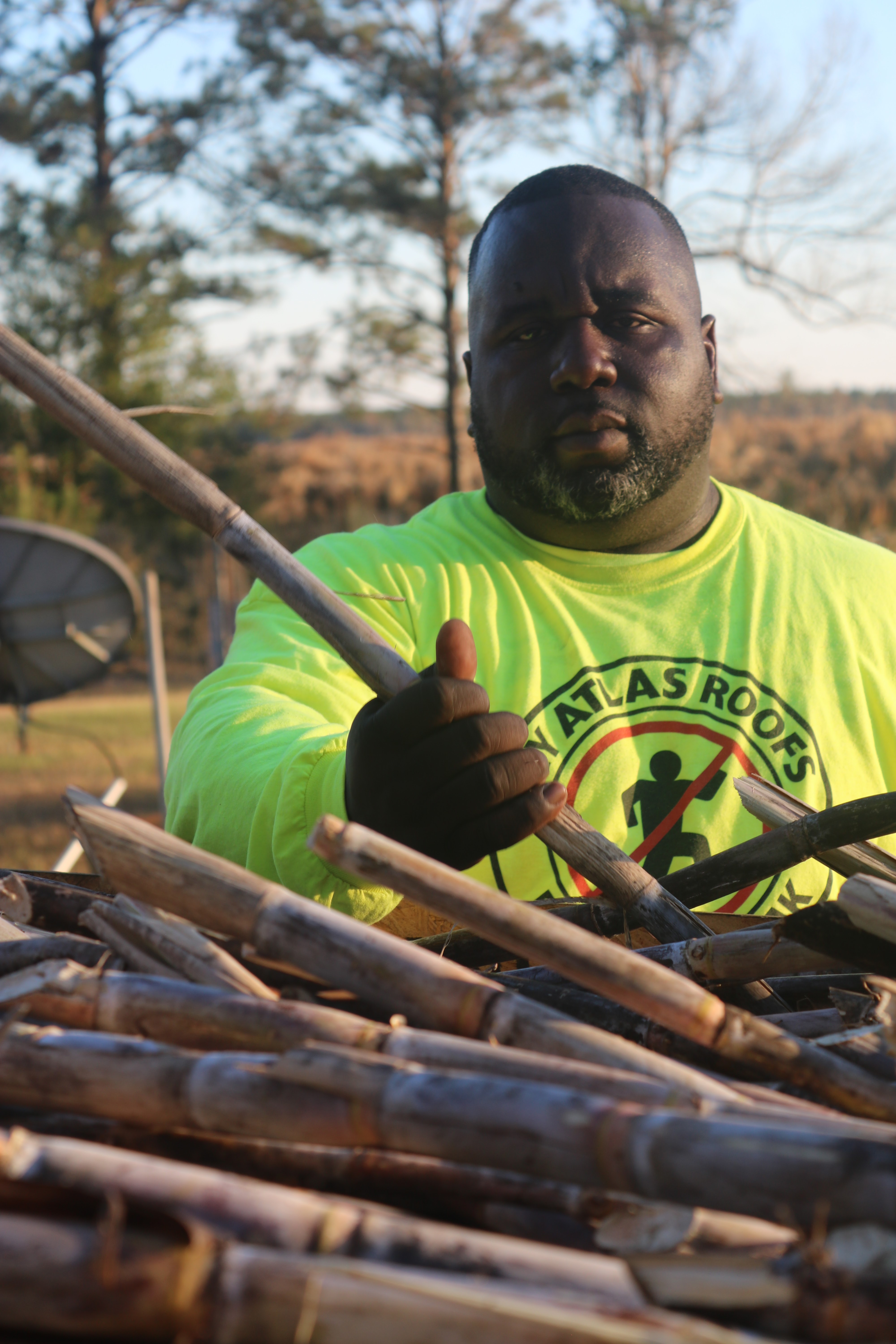
I began my morning by visiting Mr. Quincy Walker's farm. The dense fog that blanketed the Northshore did not prevent us from heading to the farm. After the fog cleared, I toured his 35-acre farm in Tangipahoa. As soon as I arrived in the area, he was waiting for me on the main highway in a Ranger Kinetic. Because of the mud, he informed me that my car would not be able to pass. 

I was eager to begin taking photographs and recording videos with my camera gear. Due to medical reasons, he was unable to get to the farm this summer. The moment his health permitted him to return to farming, something he "enjoys" doing. The area he took me to was a sugarcane field. He planted two types of sugarcane, blue ribbon and banana. John Womack gave me some seeds from his place for the cane you see right here.  The sugarcane stalks need to be cleaned of dead leaves, which he wants me to watch him do. He wore a long sleeve shirt to protect his skin from the sharp blades of the long and thin leaves that can cut you. "You don't want this to cut you," Walker said. When you take a bath, you talk about something that stings you, and it hurts," he said. 

Quincy Walker
Photo Credit: Antoinette Harrell
He drove me around the farm to look at the many rolls of sugarcane. The next step is to cut and stack it in bundles for the mill. To document their process of cutting it down and stacking it, I asked him if I could
join them. I was assured it would be fine if I documented the process. As I watched Walker work with a tool that he designed to make the job easier, I was equally impressed with his ingenuity. He made a handle that appeared to be 6 feet long to reach the tall stalks. He said, "I made the handle myself." In order to reach the top of the tall stalks, I needed a handle that was long said Walker. 

Some of his agricultural knowledge came from his ancestors and older people in the community who were farmers as well as his Indian heritage. We knew how to survive he said. This is why I enjoy talking with him and most importantly learning from him. For the most part he gets help here and there. When no one is available, Walker does most of the farm work by himself. A part of the farm is also used for raising cattle. I anticipate watching him work his crop on his farming the upcoming days.