Thursday, December 8, 2022

Quincy Walker is still working his farm at 85 years old

Quincy Walker
Photo Credit: Antoinette Harrell
I began my morning by visiting Mr. Quincy Walker's farm. The dense fog that blanketed the Northshore did not prevent us from heading to the farm. After the fog cleared, I toured his 35-acre farm in Tangipahoa. As soon as I arrived in the area, he was waiting for me on the main highway in a Ranger Kinetic. Because of the mud, he informed me that my car would not be able to pass. 

I was eager to begin taking photographs and recording videos with my camera gear. Due to medical reasons, he was unable to get to the farm this summer. The moment his health permitted him to return to farming, something he "enjoys" doing. The area he took me to was a sugarcane field. He planted two types of sugarcane, blue ribbon and banana. John Womack gave me some seeds from his place for the cane you see right here.  The sugarcane stalks need to be cleaned of dead leaves, which he wants me to watch him do. He wore a long sleeve shirt to protect his skin from the sharp blades of the long and thin leaves that can cut you. "You don't want this to cut you," Walker said. When you take a bath, you talk about something that stings you, and it hurts," he said. 

Quincy Walker
Photo Credit: Antoinette Harrell
He drove me around the farm to look at the many rolls of sugarcane. The next step is to cut and stack it in bundles for the mill. To document their process of cutting it down and stacking it, I asked him if I could
join them. I was assured it would be fine if I documented the process. As I watched Walker work with a tool that he designed to make the job easier, I was equally impressed with his ingenuity. He made a handle that appeared to be 6 feet long to reach the tall stalks. He said, "I made the handle myself." In order to reach the top of the tall stalks, I needed a handle that was long said Walker. 

Some of his agricultural knowledge came from his ancestors and older people in the community who were farmers as well as his Indian heritage. We knew how to survive he said. This is why I enjoy talking with him and most importantly learning from him. For the most part he gets help here and there. When no one is available, Walker does most of the farm work by himself. A part of the farm is also used for raising cattle. I anticipate watching him work his crop on his farming the upcoming days.

Wednesday, December 7, 2022

L.S. Spears shares knowledge of history, civil rights, and farm life in St. Helena Parish

L.S. Spears
Photo Credit: Antoinette Harrell
A few years ago, I had the pleasure of meeting Mr. Spears and his wife Mrs. Arizola Ernest . They both had so much wisdom and knowledge to share. I could have sat and talked with them for hours.  I didn't want to  overstay my welcome. They are now in their nineties and doing well. Since COVID prevented me from visiting their home, I often wondered how they were doing. During the past two weeks, I've been documenting syrup making at the Womack Mill in St. Helena. 

I met his nephew, Byron Parks. Byron needed to process four loads of sugarcane into syrup. In our conversation, Byron mentioned that Mr. Spears was his uncle's wife and that she was doing well. "There is one thing to keep in mind in rural communities: you should always establish who your family is. That's one of the most frequently asked questions." 

I didn't get to the mill the next day, so I contacted Byron by phone about some photographs he sent me. He told me that Mr. Spears was at Womack Mill. The thought of seeing him made me want to get into my car and drive to the mill. We both enjoyed hearing each other's voices when Byron put him on the phone. The following day, I planned to meet with him. Eddie Ponds was invited to join me on this trip for a few interviews for The Drum Newspaper. 

Mr. Spears at Womack Mill
Photo Credit: Antoinette Harrell
 My eyes were delighted  to see Mr. Spears driving and getting around very well for a man who had just turned ninety-six. We noticed that he dressed as if he was going somewhere else other then the syrup mill the moment he stepped out of the truck. Very neat with his shoes matching his belt and you could smell his cologne. Eddie Ponds and I took out our cameras and started taking pictures and interviewing him. He was born in 1926 in St. Helena Parish to Carter Spears and Leona Rankins Spears.  According to the 1940 United States Federal Census, he had six siblings; Myrtis Spears, Hazel Spears, Reba Spears, Inez Spears, Arnell Spears, Fennel Spears,  and Carter Spears, Jr.  


His first words were that he was still bush hauling on his tractor around his house. Although Mr. Spear did other public work to support his family, he grew up on a farm. In addition to driving a truck, he also worked in construction. He talked about how hard it was back then in St. Helena Parish and the racism they encountered. "We used to sit around and sing gospel hymns in the evenings when people would come over to our house," said Mr. Spears. We had a good old time just talking and singing he said. Whenever the people were ready to go home, we would walk them half way home and talk. He laughed when he thought about them turning around and walking back with them. 

There were times when the old folks would pray so hard in the house that you thought God was just around the corner. In those days, times were hard, but they were good as well. He said things have changed now. During his season of making syrup, he would make two to three hundred cans. Our meat was kept in a smokehouse. There is no comparison between meat today and the meat we had in the past. 

The civil rights movement was one of the topics I asked him about. They protested for equal rights in schools, he said. As a civil rights leader in St. Helena, his mother-in-law Pearl and her sister Martha Thomas were very active. In fact, Andrew Young and other members of The Student Nonviolent Coordinating Committee (SNCC) attended Pearl's funeral. It was some hard time he said. 


Mastering Syrup Making with Floyd Womack with St. Helena Parish

Floyd Womack
Photo Credi: Antoinette Harrell
The season for making syrup is a very short one. It may last two to three weeks and it's over until the next year. For the past two weeks the Womack brothers have spent long days and hard hours grinding and making cane syrup. It took me a couple days to learn the routine of each person. Floyd is somewhat a quiet man and the master cook as far as I'm concerned. He is the one who get the pans and the fire ready for cooking,

When the juice from the sugar is pumped into a 55 gallon barrel, he is ready to light the fire. Using fat pine from aged pine trees. Older people call it lighter knots. I know it works very well at getting a fire started because I used it in my fireplace. Floyd works for approximately five to six hours cooking, skimming the foam that accumulates on top of the syrup as soon as he gets the cane juice into the pan. I was amazed at how he knew how much wood to use and how he operated all three pans. He didn't stop until the job was finished and no one 

By looking at everything, he gauges everything. I asked him how he maintains the temperature of the second pan. The pieces of wood are thrown under the second pan, he explained. The same thing for the third pan. I also asked him if he ever messed up any syrup while cooking it. "Yes! Many times", replied Floyd. Through trial and error, you learn to become better he said. 

Floyd Womack making syrup
Photo Credit: Antoinette Harrell

He reminds me of a master chef - a man who knows his craft well. As soon as he gets the heat under the pans right and they start boiling, he's working over the hot steaming pans. At that point, everything is in his hands. He wants to ensure that the syrup batch is good. Not too thick and not too watery. Hats off to the chef, as they say. Hats off to the master syrup maker in this case. He spent years and learning to master his skills. 

 My attention was drawn to the fact that he was the only one cooking. It is my hope that someone will learn syrup making from him so that this cultural preservation can continue for as long as possible. There aren't many people left in St. Helena Parish who still make cane syrup. 

The importance of preserving and highlighting these types of crafts cannot be overstated. Quilt makers, basket weavers, wood carvers, and other crafts that people enjoy. The Womack men enjoy making syrup as a hobby.  There are a lot of areas in Louisiana that are known for their culture, food, music, and crafts. The Strawberry Festival, the Oyster Festival, and the Sicilian Festival are held every spring in Tangipahoa Parish. The Dairy Festivals in Kentwood, Louisiana were often mentioned by others. As far as I know, St. Helena Parish does not have any festivals. Through video and photography, I documented the process this season. It is my second time documenting the process. When I first visited a syrup mill about five years ago, James Baker was the master syrup maker. He has stopped making cane syrup, I was told.


Sunday, December 4, 2022

The 4th great-granddaughter of whipped Peter discusses the movie Emancipation with Dr. Antoinette Harrell

Dr. Antoinette Harrell interviewing Bobbie Seymour 
I recently spoke with Kathe Hambrick, founder of the River Road Museum, about a woman named Bobbie Seymour, whois the 4th great granddaughter of Aaron Peter Jackson aka Peter Gordon. I was asked by Kathe if I would assist Bobbie in getting past her brick wall regarding her 4th great grandfather Peter. Our conversation briefly focused on Will Smith's upcoming film, Emancipation, and how the family wasn't consulted about Peter.

Like Bobbie, I felt the same way earlier this year when I watched the movie "Alice," which was based on a story I discovered 20 years ago. In 1963, a woman named Mae Louise Wall Miller escaped slavery with her family. Despite the fact that it was inspired by my research, no one from the production team contacted me to discuss my research.

Contacting the families or researchers would provide the film producers with so much information about the subject. The movie Alice was criticized for not adding up after Mae ran to her freedom, as many people pointed out. Mae's life after she escaped would have been more interesting if the producers had known more about it. 

Aaron Peter Jackson aka Peter Gordon
Library of Congress

The Jackson family is a very large family, and many Jackson family members still live in Port Hudson. "I wish they would have searched around to talk with some of Aaron Peter Jackson's descendants," said Bobbie. We weren't difficult to find if only they would have spent sometime searching for us she said.  I am happy to see that his tory is being told in the end said Bobbie

We talked for about an hour during our interview. Her coffee table was covered with pictures and documents of her grandfather Peter and other family members. Additionally, she showed photographs that she inherited from a family member illustrating her Cherokee heritage. During our visit, Bobbie showed me a picture of Ruby, her 5th great grandmother, a full blooded Cherokee. Ruby was Peter's mother-in-law. Ruby was from Summit, Mississippi.

I asked Bobbie if she thought she would be emotional watching Emancipation. I warned her that the reenactment of the beatings and inhumane treatment may be difficult to watch. There are movies that can make you cry if they touch you in a particular way. If a movie is about your family member and you are watching inhumane treatment, the experience is personal. In any case, that could be a very difficult situation. The Jackson's are strong people she said. We don't allow anything to hold us down. If something knocks us down, we get right back up. That was we inherited from Peter, determination, courage, and hold on to God no matter what we are faced with Bobbie said.

She described the Jacksons as strong people. There is  nothing that can hold us back. No matter what knocks us down, we bounce right back up. As Bobbie said, it was determination, courage, and holding on to God no matter what that we were facing that we inherited from Peter.  Her research revealed his name, something that has been a little confusing down through the decades. There are a few things that Bobbie want people to know first is his name. His name isn't Peter Gordon, his name is Aaron Peter Jackson.
Secondly he wasn't born in Louisiana. He was born in Virginia and came to Louisiana as a slave. He was owned by Andrew Jackson on a plantation in Tennessee according the research of Bobbie. Andrew Jackson owned The Hermitage plantation. 

Bobbie plans to watch the movie with family and friends. I will contact Bobbie after she see the movie and get her thoughts about the movie. I spoke with the editor of The Drum Newspaper concerning interviewing Bobbie about her family history and thoughts about the upcoming meeting.  There was a time when we didn't have the platforms to tell our own stories. The only thing Bobbie feels she has achieved is to tell her own story.


Tuesday, November 29, 2022

65 years old man born on a plantation in Norwood, LA


James "Moon B" London
I spent the few last days at  Womack Syrup Mill in St. Helena Parish. It was a pleasure to meet some very interesting individuals. One of those people was James London aka Moon B, whose task was to unload the sugarcane from the trailer. He struck up a conversation with me while I was taking photographs of him unloading the sugarcane. He discussed the sugarcane plantation he grew up on in Norwood, Louisiana, where he was born and raised back up in the woods.

"I was born on a plantation in the woods in Norwood, Louisiana. I remember the name of the midwife who delivered me there." Her name is Lucy Porter, yeah, that's right, said Moon B." When Moon B told me his age, my heart ached for more information on his life on the plantation. I wish I had more time with him to interview him and document his story. 

He is only three years older than me and is sharing his experiences living on a plantation. He was born into a system of sharecropping. As a result of his family's hard work and sacrifice, they were not able to get a head he said. We just always broke even, yeah, we couldn't do anything about it Moon B said.

I asked him how  his family left the place.  He explained to me a fight that one of his uncles had. After one of my uncles got into a fight and someone was killed, the owner told us we had to leave. "I witnessed them beating my uncle on the plantation, yeah, I recall that, said Moon B."


E.J's first photo shoot with Dr. Antoinette Harrell, Local Historian

E.J. taking pictures at the Womack Syrup Mill
Photo Credit: Antoinette Harrell
Documenting history through still shots and video is something that I do as a hobby. I find relaxation and learning something new with each adventure. Not to mention meeting some very interesting people along the way. In the event that I am not able to continue or when I am gone. When my four grandkids were growing up, I placed a camera in each of their hands to see if anyone found it interesting and explored taking pictures. No, it is not for everyone and cannot be forced upon someone, regardless of how important you think it is.

E.J.'s grandmother told me he liked to take photographs. I had a camera that I no longer use and thought it would be a suitable starter camera for him. I invited him to take photographs at the Womack Syrup Mill in St. Helena Parish. He was eager to participate in his first photo shoot. As soon as we arrived, E.J. immediately began taking photographs. I look forward to seeing his photographs. He is certainly an explorer, that's for sure. If possible, I would like to see a newsletter or a display of some of his photographs at his school. This would really inspire him. In light of the fact that we are getting a new and larger library, perhaps some of his images could be displayed in the section for children or local history.

Mr. John Womack invited E.J. to photograph youth who are passionate about farming,  agriculture, and livestock. He would benefit greatly from such an experience. Many older people who are involved in farming, agriculture, livestock, and other areas stress the importance of teaching the youth and preserving traditions. In fact, I'm doing exactly that with E.J., teaching him how to record local history using his camera.

E.J. taking photographs
Photo CredIt: Antoinette Harrell

As an alternative, he may wish to travel around the world with his camera.  I wish to emphasize that E.J  is a fast learner and one who is likely to ask a thousand questions. Talking with people and offering assistance is not something he is shy about. As a matter of fact, he was simultaneously learning about syrup making and taking photographs. 

During the cooking process of the syrup, Mr. John Womack gave him the assignment to test the temperature. So E.J., was in between the camera and the laser tempertaure tester. Overall he had a great experience. I'm looking forward to inviting him out to his next photo shoot. He was gifted a bottle of syrup for helping to bottle up the syrup. This was an experience he will never forget. All we need to do is invest in our youth and sit back and how the growth.  E. J. is a natural and I look forward inviting him to come along and what that other children will want to join us. 

Wednesday, November 23, 2022

Womack Family Making Syrup in St. Helena Parish

Larry Womack
Photo Credit: Dr. Antoinette Harrell

During the summer of this year, I participated in a farm tour in Lexington, Mississippi with farmers from St. Helena and Tangipahoa Louisiana Parishes. Kenwtood was their last stop before heading down the highway, so I had to meet them at 5:00 a.m. I met many farmers and agriculture-interested youth on the bus. 

Cedrick Womack was sitting several seats behind me on the bus. The subject of his family farm was not discussed that day. In the following week he contacted me with information about the syrup making business in his family. Several years ago, I watched James Baker make sugar cane syrup. Observing the entire process for the first time, I gained an insight into the entire process. Each November, Baker drove thirteen hours from Chicago to Louisiana to produce syrup. 

I was invited by Cedrick to interview his father and uncles and take photographs and video them making syrup as well. As the time approached for the syrup to be made and produced, he contacted me to remind me to come out and document the process. During the twenty-minute drive to their location, the scenery was picturesque. It is dotted with tall pine trees and curvy roads on the way to the syrup mill. The Womack family had already begun cooking the syrup and was in the process of bottling it. 

Cedrick Womack Bottling Syrup
Photo Credit: Dr. Antoinette Harrell
In the course of the interview, I wanted to ask each brother about the process of making syrup. During the preparation of the syrup, they were making it for Larry. Larry's brothers Johnny, Floyd, Richard, and Morris "Buddy" Womack assisted him. Our family works together in this way, explained Johnny Womack, Sr. Their parents Walter and Sally Pitts Womack were the parents of 18 children. A total of eight sons and ten daughters were born to the couple.

The art of syrup making was mastered by each brother. Floyd skimmed off what they referred to as trash from the syrup as they boiled it. He remained busy skimming the trash that was left after boiling the syrup. As Larry checked the temperature, Johnny appeared to be keeping an eye on everything. 

 Following  preparation of the syrup, the containers could be filled with the syrup. The containers were prepared by Cedrick, his uncle Richard, and Larry's grandson Lemarye Womack, Jr. The Womack brothers were raised on farms and have a strong sense of family. A total of 30 acres of land were farmed by them. In fact, farming is ingrained in their DNA; it is not something they are unfamiliar with. This Friday after Thanksgiving day, I will meet them at the mill at 7:00 a.m. to watch and document from start to finish. 

Saturday, November 19, 2022

Kids Exploring Photography

Kids and Photography
Photo Credit: Dr. Antoinette Harrell
Children learn more than just how to take good photographs when they are taught photography Photography encourage kids to explore their creative talents. In the long run, it will help you develop valuable skills in critical thinking and visual perception. I'm always inspired to support children who have an interest in photography and filmmaking. A friend of mine told me how much her grandson E.J. enjoys taking photos. Since I had an extra camera that I wasn't using anymore, I decided to donate it to E.J. He was so thrilled when his grandmother brought him to my house so he could pick up his camera and accessories. Immediately, he began exploring the camera. 

I have a collection of antique cameras that I showed him. From instant polaroids to film cameras. E.J., is growing up in the digital age. A film-based camera is most likely something he hasn't seen before. One of the conversations we had was about how he could earn money and travel internationally with a camera in his hand.

I suggested he ask his teacher at school can he start a photograph club and document school.For students who share the same passion for photography, setting up a photography class can be a great opportunity. Displays of images can be arranged at the school. Club members can invite guest speakers to speak at their meetings.   Every child who had a phone has a camera. They enjoy having their pictures taken most of all. I would enjoy looking at some of E.J.'s creative work and images. 

As we talked about  photography, I mentioned to him that I had friends and associates who took pictures for National Geographic, Planet Magazine, and many other magazines. They have contributed images to documentaries and films. In the event that E.J. succeeds in starting a photography club, I will support him and the club members.


E.J exploring cameras
Photo Credit: Dr. Antoinette Harrell


An historical look at the birth of the Drum Newspaper in Tangipahoa Parish

Eddie Ponds
Photo Credit: Dr. Antoinette Harrell
During my interview with Eddie Ponds, I asked him about how the Drum Newspaper was developed. He said he and his wife Carrie attended Southeastern Louisiana University to hear Julian Bond, a leader in civil rights, politician, social activist, author, and professor. As his eyes glanced around the room, he didn't notice any press.

Julian Bond founded the organizations: Student Nonviolent Coordinating Committee (SNCC) and Southern Poverty Law Center. As a matter of fact he could not recall seeing it mentioned in the local press. He and his wife discussed the matter further after the event. His wife suggested he start his own newspaper to make a change. 

There have been over 40 years since then, and The Drum Newspaper is still covering African American news throughout Louisiana's Southeast Parishes. When I asked Eddie if he had any older issues I might be able to review, he replied that he had. He had editions as far back as the development of the newspaper. The news archives sounded like music to my ears, and I couldn't wait to explore them. The newspaper holds a piece of African American history that cannot be found anywhere else in Louisiana FloridaParishes. Many of the photographs Eddie used in the early editions of the newspaper were taken by him. The black and white photographs he took were developed in his darkroom.

The Drum Newspaper Publisher  Eddie Ponds
Photo Credit: Dr. Antoinette Harrell
We discussed the possibility of contacting the Center for Louisiana Studies to start a collection in memory of Life over the delicious dinner he and his daughter Sharon prepared. The collection would consist of 30 years of history. As a genealogist and local historian, I'm aware of the importance of this collection for researchers, students, historians, and scholars learning about the history of African Americans, whose rich and notable history was disregarded and undocumented. 

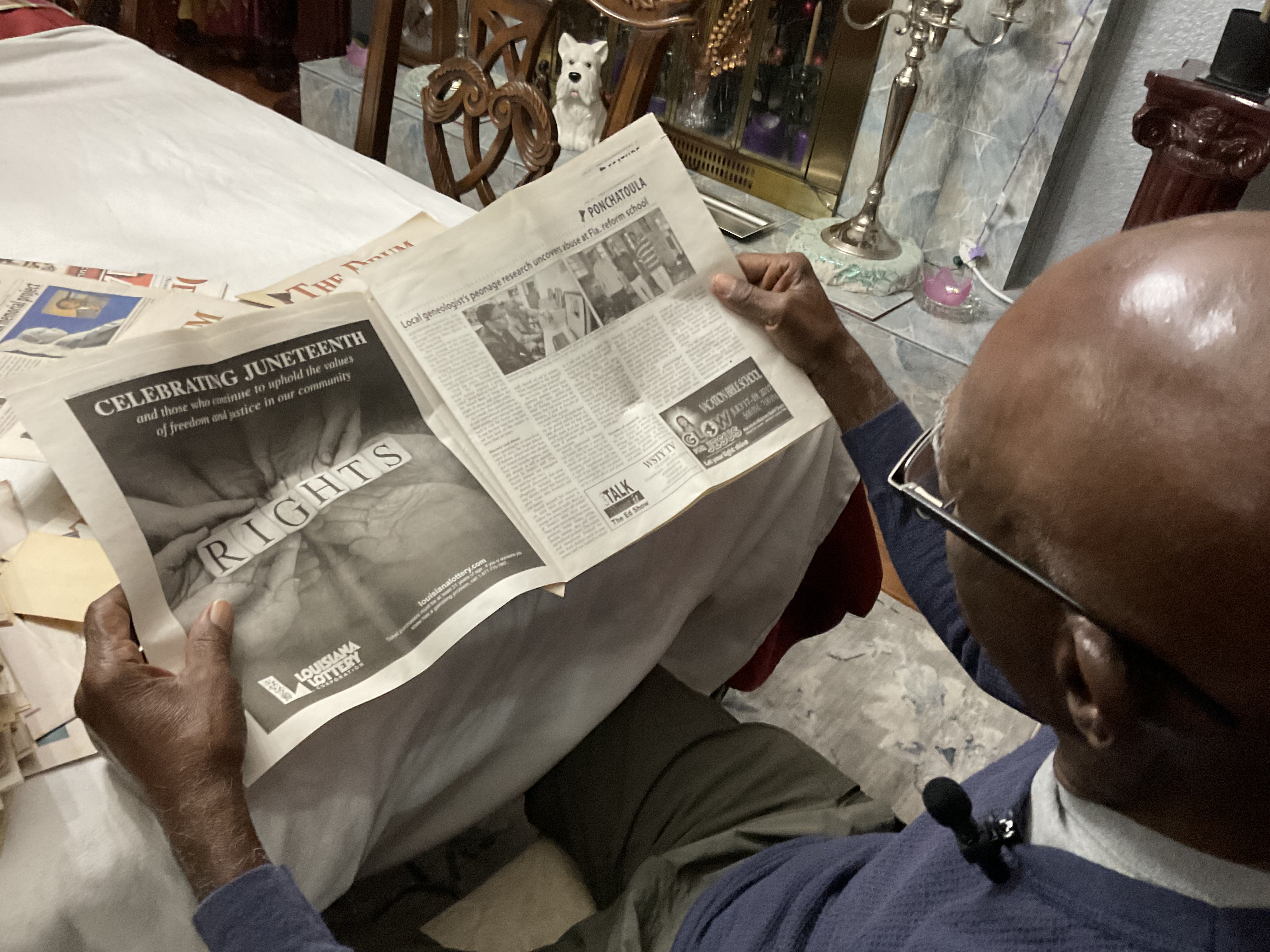
Ponchatoula Colored School's article provided me with a lot of information I hadn't previously seen. A number of black educators as well as one of the school's principals were named in this article. In response to the blog post, I received several phone calls. In their calls, the callers indicated that they had learned something about the school. history through reaching the electronic reprint. During integration, much of the history of colored schools was destroyed. Throughout Tangipahoa Parish, it is difficult to find the history of black schools. It is quite impressive how much of the history of the O.W. Dillon School was preserved in Kentwood, Louisiana. 


Monday, November 14, 2022

Louisiana African American History Makers (Reprint the Drum Newspaper)

Homer Plessy,  challenged a two year old street car law that departed passengers traveling on trains in Louisiana. His action made him a plaintiff and defendant in the landmark. U.S. Supreme Court Case of Plessy v.s. Ferguson in 1896. March 17, March 1, 1925.

Dr. Walter A. Reed, First Black Physician Tangipahoa Parish. 1875-1945

Gideon Tillman Carter, Sr, Principal, coach, community leaders, and was the first Black elected to  Ponchatoula board of aldermen since Reconstruction.  March 15, 1924- November 1,  1984. 

M.C. Moore filed a lawsuit in 1950 against the Tangipahoa Parish School Board in Tangipahoa Parish. The case was won. The school system is still operating under federal court orders.

"Coach" Reginald A. Cotton, Sr, was one of the Tangipahoa Parish most successful football and track coaches. He later served not he Tangipahoa Parish School Board. November 4, 1927- December 9, 1986

Wilbert Lee Dangerfield, Hammond's first black councilman. He served from 1977-1994. The community activist served on the board and held membership in many organizations to help community throughout Tangipahoa Parish. August 30, 1937- July 18, 2011

Joyce Marie Moore vs. Tangipahoa Parish School Board is one of the most famous lawsuits in Tangipahoa Parish. This case has been in court for more than 50 years. 

Forchia Mae Wilson, Educator, community leader, founder and curator for Sweet Home Museum in Kentwood, LA. May 9, 1925-March 26, 2011

Edwin H. Wilson. The first black to teach tailoring to veterans in Tangipahoa Parish. He later became a full time tailoring teacher in the Tangipahoa Parish School System. October 28, 1918-November 20, 1980

Micheal D. Jackson,  Jackson played for the NFL after he was selected by the Cleveland Browns in the sixth round of the 1991 NFL Draft. A  wide receiver from the University of Southern Mississippi. Jackson played in eight NFL seasons from 1991-1998 for the Browns and the Baltimore Ravens before retiring. He was the first professional football player from Tangipahoa Parish. 

Melvin Lee "Kip" Holden, On November 3, 2004, he was elected as the first Black Mayor-President of East Baton Rouge Parish. August 12, 1952

Dr. Leo Stanley Butler, In 1918, Butler was the first male to receive a diploma form what became McKinley High School. IN 1926, he began a lifelong practice of medicine and community service. He was known as the "Dean of Black Physicians." He was named General Practitioner of the Year" by the National Medical Association in 1962. Both the East Baton Rouge Medical Society and the East Baton Rouge Medial Association honored him for outstanding community service.  August 12, 1899 to September 8, 1978. 

Arna Wendell Bontemps, is famous for his books featuring black characters, he wrote many notable pieces including God Sends Sunday (1931), Black Thunder (1936), The Story of the Negro (1948) and Great Slave Narratives (1969). October 13, 1902-June 10, 1974

Ernest Nathan "Dutch" Morial, lawyer, judge, State Legislator, and mayor. He was born in New Orleans, in 1977 he was elect the first Black mayor of the City of New Orleans. October 9, 1929-December 24, 1989.


Friday, November 11, 2022

John Wesley Richardson 1885-1952

John Wesley Richardson
1885-1952
Photo Courtesy: Lorraine Deemer Lizana & Supt. Jimmy Richardson

John Wesley Richardson ws born on August 15, 1885 in Darlington, St. Helena Parish, Louisiana and died on November 8, 1952 in New Orleans according to the Louisiana U.S. Statewide Death Index, 1819-1964.  He is buried at Black Creek AME Church Cemetery in St. Helena Parish. He was married to Minnie Ada Richardson.  They were the parents of:  Emmett Nathaniel Richardson, John W. Richardson, Inez Richardson, Myrad T. Richardson, Gladys Richardson, Mildred Richardson, Janie Richardson.   and Flora Christine Williams.

According to the 1940 United States Census, John was a farmer by occupation and he owned his land. He and his family was living on Amite Riner Road. John completed the 4th grade. 


Amanda Breland Richardson and Great granddaughter Isabel Harrell Cook

Amanda Breland was born in 1862 and died in 1937 in St. Helena Parish.  Her  husband was Thomas Richardson, Sr.,  There were five children born to them: Sophia, John, Thomas, Jr., Golene, and Annie Richardson. The picture shows my mother Isabell Harrell Cook when she was about seven years old. Her picture standing with her maternal great grandmother was photoshopped. My mother was born on December 25, 1939 and died on March 30, 2020.

Our Family Heirloom

Crock Bowl
Photo Credit: Antoinette Harrell

My second cousin Juanita Harrell Stewart inherited two of these bowls  you see in this picture from her mother Minnie Nolan Harrell. I can't help but think of them each time I use the bowls that I inherited from her. Over the course of four generations, my family has handled these bowls.  This crock bowl looks in amazing in Farmhouse kitchens. Many delicious meals was made in the vintage stoneware bowl.

Gideon T. Carter An Educator and Political Leader in Tangipahoa Parish

Gideon Tillman Carter
Gideon Tillman Carter, 1924-1984, believed in a powerful of God, a solid education, and strong work ethic. Carter was the son of Rev. Gideon T. and Virginia Jones Carter  on March 15, 1924 in Baton Rouge. Carter's life was filled with many hard earned accomplishments and milestones. At the Age of 17, he volunteered for the Army, In 1951, Carter received an Army commission as second lieutenant from Southern University R.O.T.C Carter obtained a bachelor's degree in industrial and technical education that same year.

In 1951, Carter became the classroom teacher in the Tangipahoa Parish School System. He was appointed principal of Perrin Junior Hight School in Ponchatoula in 1958. In the sixties, he was instrumental in organizing the first Head Start Program in Tangipahoa Parish. In 1967, Carter was appointed to organize a news elementary school in Ponchatoula now D.C Reeves. 

Realizing the advantages of a coeducation environment. Carter worked hard to implement a system of coeducation in the lower elementary schools in Ponchatoula witch included D.C. Reeves and Tucker Elementary Schools. These schools became coeducational in 1977 after Carter submitted his proposal of coeducation vs. separation by sext in the lower elementary school to the Tangipahoa Parish School Board. 

In 1971, he earned an education master's degree in supervision and administration form Southern University,  Baton Rouge. In 1974, he earned 'plus thirty' hours from Southeastern Louisiana University with certificate as school principal, supervisor of student teaching and visiting teacher. He was also certified as city or parish supervisor and supervisor of the child welfare and attendance.

A committee man, he knew the value of education and hard work. He spent much of his life trying got install these values and ideas into  the children and the community. Very active in the community, he was visible, honest participant in government and a caring teacher.

After his retired from the Tangipahoa Parish School System he was employed by Evangeline Parish  Community Action Agency in Ville Plate, working as a counselor from August 1979 to June 1981. He worked in 15 parishes setting up the job training programs for junior and senior hight schools, to keep them from becoming dropouts.

Carter was the first black elected city official in Ponchatoula. In April of 1980, he was elected Aldermen of the Fourth District in the City of Ponchatoula. He also had the occasion to serve as mayor pro-ten. In July 1981, Quad Area Community Action Agency in Hammond hired him as parish coordinator. He implemented the Home Provider Child Care Program in this parish and headed a federal food distribution program parish wide.

Carter's drive and ambition was and asset to every organization he was involved in and every person he touched. He was an active member of the following organizations: The Louisiana Association of Education, The Tangipahoa Education Association, The Board of Directors of Hammond Mental Health Center, Disabled Veterans Chapter #16 and the Prince Hall Mason. He was one fo the five board members and the first black appointed to the U.S. Army Selective Service System Board 64 of Hammond.

His wife, Mary Deemer Carter, and his four children are committed to keeping the spirit of his ambition and determination alive. Attorney Gideon T. Carter III, resides in Louisiana, are does Gwendolyn R. Carter and Genor E. Carter reside in Denver.

Gideon T. Carter was educator, administrator, organizer and political leader. He believed in education for all people. He encouraged children to strive for the best education possible.


Written and Published by the family of Gideon T. Carter

Reprint: Nurturing Our Roots Blog

Source: The Drum Newspaper

Wednesday, November 9, 2022

The Historic Mt. Canaan Elementary School


Photo Courtesy of
Mrs. Grace Belvins  Walker

The land for the school, church, and cemetery was donated by Robert "Free Bob" Vernon in the Arcola/Roseland area. The old school building was demolished not long ago. Former students and descendants of Robert "Free Bob" Vernon frequently reminisce about their experiences at the school. Mrs. Grace Belvins Walker, one of Free Bob's descendants, is among those who recall those times. The extensive collection of photographs preserves many stories from that era for her.

Burnell Muse of Muse 3 Farms Hibiscus Plants

Burnell Muse
Muse 3 Farm
Photo Credit: Antoinette Harrell
Burnell Muse, an agriculture and natural resource agent with the Southern University Ag Center. Every Friday from 8:00 a.m. to 12:00 noon you can find Burnell sitting at his booth distributing tokens for SNAP customers at the St. Helena Farmers Market. The market offers a SNAP match program, which provides $3 in free tokens for every $1 spent on eligible food like fresh produce using SNAP benefits. 

 During my visit to Muse 3 Farm, I interviewed Burnell Muse and several of his brothers. His attention was drawn to the hibiscus plants on the farm while driving around. It is estimated that there are several hundred species of flowering plants native to warm climates. From the flowers of the Hibiscus plant, a delicious tea can be made. Cold or hot tea can be served. My favorite way to start my day is with a hot cup of Hibiscus, peppermint, or ginger and turmeric tea in the morning. This is followed by a cold glass of tea with some honey throughout the day. I find it to be so refreshing and tasty. Matter of fact, it is one of my drinks for comfort. 

Hibiscus is described as having a number of medical uses. It is said to lower blood pressure. In Asia and Africa, hibiscus has been used to treat high blood pressure for centuries. Be sure to check with your primary care physician before taking this natural approach. Other health benefits of Hibiscus tea, it can be used to lower cholesterol, manage diabetes, protect the liver, aid in weight loss. Please see the links below for more information about Hibiscus Tea.


Links

www.muse3farm.com

https://facty.com/food/nutrition/health-benefits-of-hibiscus-tea/6/

Eddie Ponds, Publisher of The Drum Newspaper Visited the Gravesite of Rev. Arthur Tasker


Eddie Ponds 
At the Gravesite of Rev. Arthur Tasker
Photo Credit: Antoinette Harrell

Eddie Ponds and I often hold conversations about Rev. Arthur Tasker, the first and only black mayor to ever hold the seat as mayor in the City of Ponchatoula, Louisiana. Rev. Arthur Tasker also started Tasker's A.M.E. Church. According to the 1870 United States Federal Census, he was born around 1835 in Virginia. He married his wife Sarah Smith Tasker in 1887 in Tangipahoa Parish,

The children listed in the 1870 census were: David Tasker, Clinton Tasker,  Mary Tasker, and Harriet Tasker. In the 1880 United Census the children listed were: Wm. C. Tasker, Levina Tasker, Amma Tasker, Lois Tasker, and Augretia Tasker.

For years Eddie Ponds and I have been talking about the need to place a historic marker in Ponchatoula for Rev. Arthur Tasker. We both know how important these historic marker are.  There isn't on historic marker from Ponchatoula to Kentwood, Louisiana.

Mr. Quincy Walker a Local Farmer in Tangipahoa Parish

Quincy Walker
Photo Credit: Antoinette Harrell
Quincy Walker was born in 1937 in Tangipahoa Parish, Louisiana. His parents were Nathan and Frances Walker. I had the pleasure of meeting Mr. Walker years ago. On a bus tour of farms in Lexington, Mississippi, I sat next to this griot. As a matter of fact, I enjoyed every minute of it. My goal was to get as much information from him as possible about family history, local history, and farming.  

Nathan Walker was born in 1919 in Bolivar, Louisiana to Albert Walker and Monnie Walker. Earnesteen Walker, Luella Walker, Esterrann Walker, Millie Walker, Charles Walker, and Lula Walker were their children. 

The year of Albert's birth was around 1888.  Mr. Quincy often spoke of the lessons he learned from his grandfather Albert, whom he called "Pa". He used many of the lessons he learned today. His grandmother used herbs to heal the family and community when they were sick, and he shared some of the things she taught him about herbs as part of his Native American heritage.  Albert's parents were Harrison Walker and Phillis Walker.  Harrison was born around 1859 in Mississippi. According to the 1900 United States Federal Census, he was living in Police Jury Ward 2, Tangipahoa Parish, Louisiana. Harrison was a farmer  by occupation. He could read and write. He was rented his home. Harrison and wife were the parents of a large family; Fetus Walker, Handy Walker, Florence Walker, Albert Walker, Charley Walker, Flancy Walker, Elizabeth Walker,  Geneva Walker, Jessie L. Walker, and Mary E. Walker.  Harrison Walker died at the age of 84 on January 29, 1939.

He is no longer able to do things he used to due to his advancing age and health problems. Upon turning 60 years old, he began farming. He regrets not starting sooner. Growing up on a farm, he had no interest in farming, so he went to college to get an education. Formerly, he was a teacher in the Tangipahoa Parish School System.